Home › Dwarf planets › Ceres
Dwarf planet
Ceres
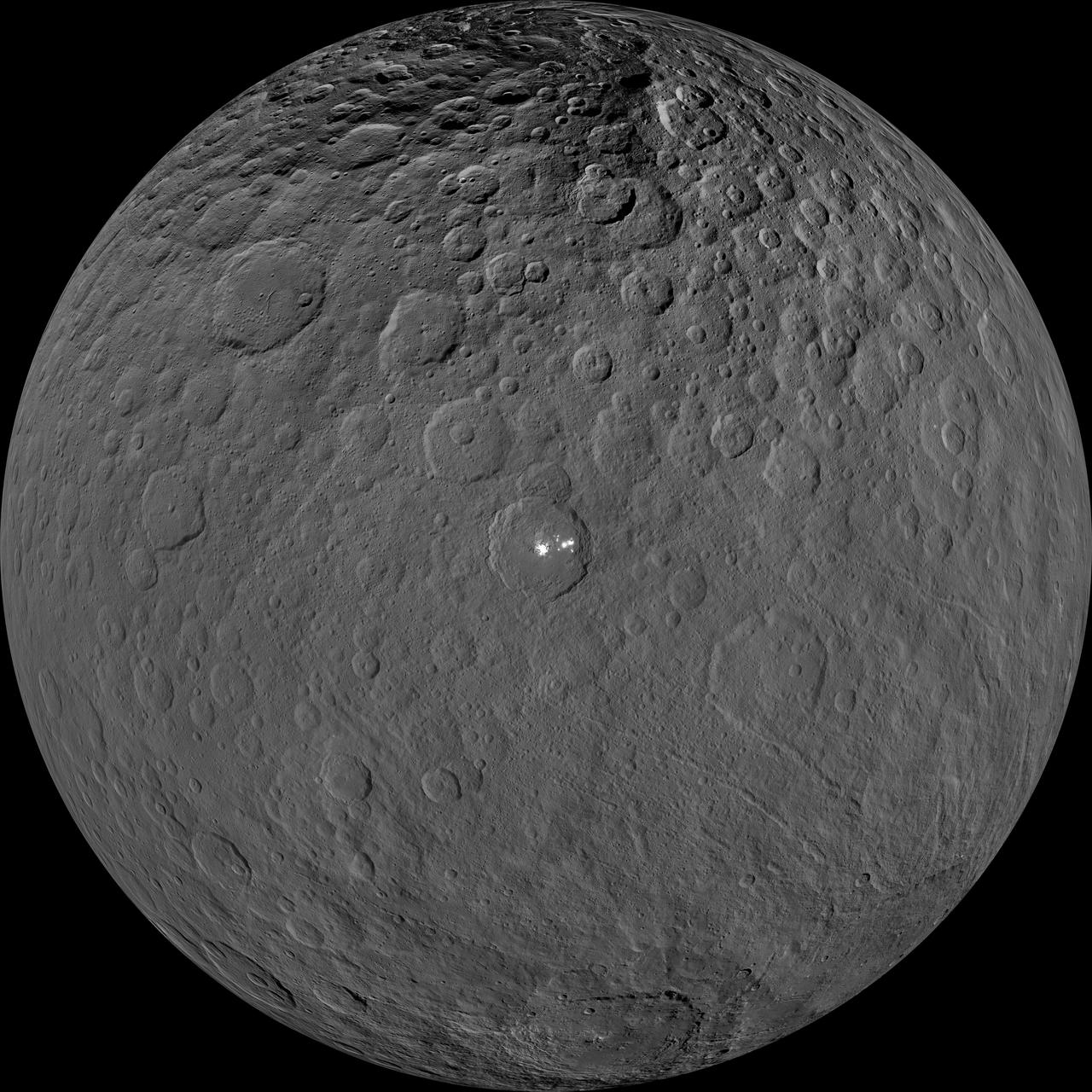
Ceres is the biggest chunk in the Asteroid Belt – so big that it is a dwarf planet. It has bright, salty spots in a crater.
Fact file
- Type
- Dwarf planet
- Diameter
- 939 km
- Distance from the Sun
- 414,000,000 km
- Orbital period
- 4.6 years
- Temperature
- -105 °C on average (from -143 to -38 °C)
- Mass
- 0.00016 Earth masses
- Gravity
- 0.03 times as strong as on Earth
- Escape velocity
- 0.5 km/s
- Length of day
- 9 hours 4 minutes
- Number of moons
- 0
Interesting facts about Ceres
- Ceres is the largest body in the Asteroid Belt and contains about a third of its total mass.
- Bright spots of salt deposits gleam in Occator crater – the remains of salty water that rose from the interior.
- Ceres was discovered by Giuseppe Piazzi in 1801; it was first considered a planet, then an asteroid for about 150 years, and a dwarf planet since 2006.
Frequently asked questions about Ceres
Is Ceres an asteroid or a dwarf planet?
Ceres has been classed as a dwarf planet since 2006. It is the largest body in the Asteroid Belt between Mars and Jupiter and contains about a third of the belt's mass.
What are the bright spots on Ceres?
The bright spots in Occator crater are salt deposits. They were left behind when salty water rose from the interior and evaporated. They were discovered by the Dawn spacecraft, which orbited Ceres from 2015 to 2018.
How big is Ceres?
Ceres has a diameter of 939 km. That is about 7.4% of the diameter of Earth.
How far is Ceres from the Sun?
Ceres is on average 414 million km from the Sun. That is 2.77 astronomical units (AU). Sunlight takes about 23 minutes to cover this distance.
How long is a year on Ceres?
Ceres takes 4.6 Earth years to travel once around the Sun.
How cold or warm is it on Ceres?
On Ceres the average temperature is −105 °C. The temperature ranges from −143 to −38 °C.
Name and discovery
After the Roman goddess of agriculture – the word “cereal” comes from her name.
Discovered on 1 January 1801 by Giuseppe Piazzi in Palermo – at first hailed as a new planet.
Formation
Ceres formed early in the history of the Solar System. Jupiter's gravity prevented a proper planet from forming in the Asteroid Belt – Ceres is a leftover “planetary embryo”.
Atmosphere
No atmosphere to speak of; small amounts of water vapour have been detected at times.
Exploration
NASA's Dawn probe orbited Ceres in 2015-2018 (after Vesta) and mapped the whole dwarf planet. Among other things, it found the ice volcano Ahuna Mons and signs of a salty subsurface.
Compared with Earth
Ceres is about a quarter of the Moon's diameter, but has only about 1.3% of the Moon's mass.
Test your knowledge of Ceres
Which dwarf planet lies in the Asteroid Belt?
Ceres. Ceres contains about a third of the total mass of the Asteroid Belt. The Dawn probe visited it in 2015.
Which probe orbited the asteroids Vesta and Ceres one after the other?
Dawn. Dawn was the first probe to orbit two different celestial bodies – made possible by its ion engine.
What are the bright spots in Occator crater on Ceres?
Salt deposits. Salty water rose from the interior and evaporated – what was left behind is mainly sodium carbonate.
The full quiz with points and badges is in the 3D model under “Explore”.
Ceres in the tours
This site is free and has no banner ads. Here is how you can support it