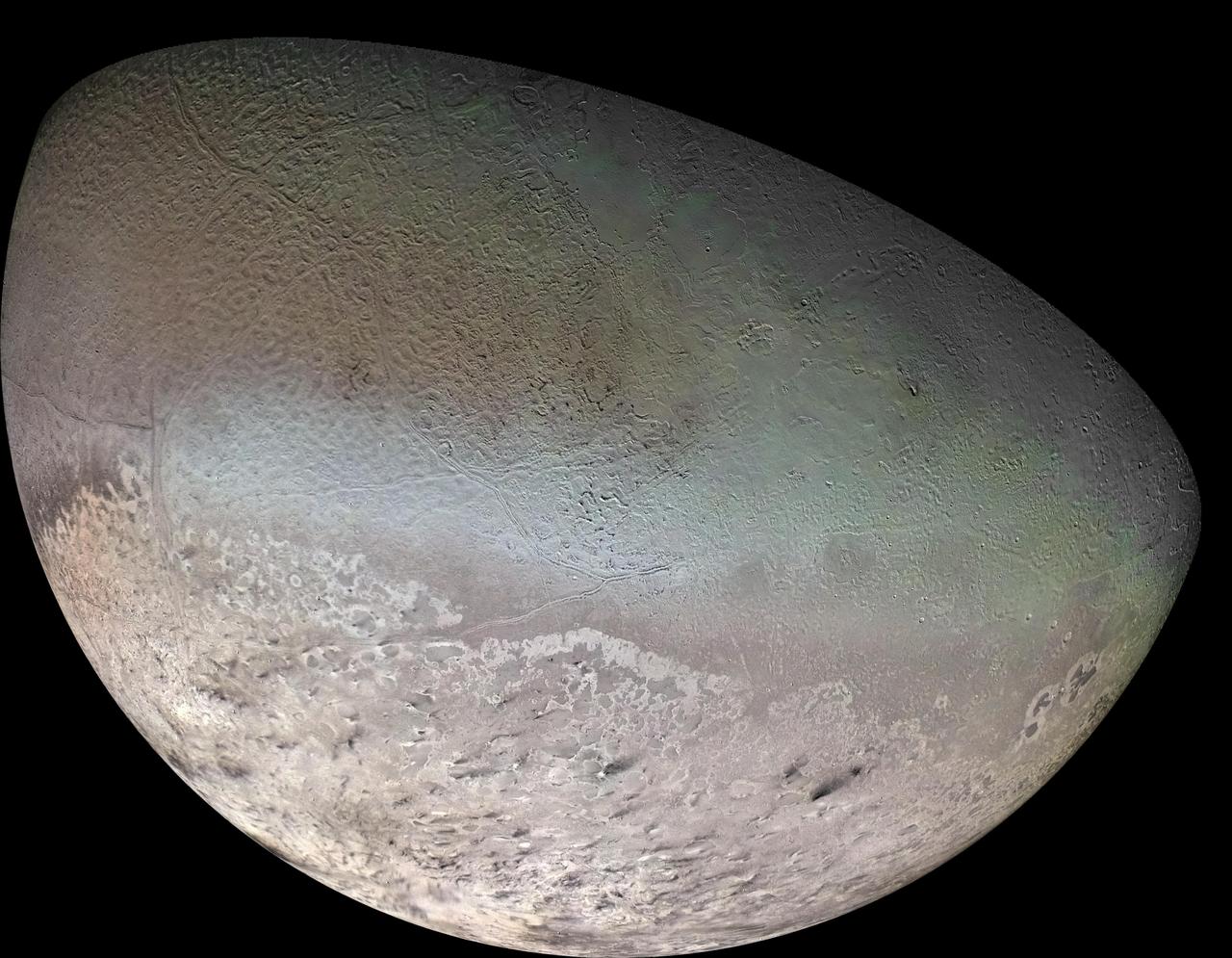
Moon of Neptune
Triton
Triton is the biggest moon of Neptune. It orbits its planet backwards. Dark fountains rise up out of its ice.
Fact file
- Type
- Moon of Neptune
- Diameter
- 2,707 km
- Distance from Neptune
- 354,800 km
- Orbital period
- 5.9 days
- Temperature
- -235 °C on average
- Mass
- 0.0036 Earth masses
- Gravity
- 0.08 times as strong as on Earth
- Escape velocity
- 1.5 km/s
- Length of day
- 5.9 Earth days (tidally locked)
Triton orbits Neptune.
Interesting facts about Triton
- Triton orbits Neptune backwards – it was probably captured from the Kuiper Belt and is a “cousin” of Pluto.
- In 1989 Voyager 2 saw geysers hurling nitrogen and dark dust up to 8 km high.
- At around -235 °C, its surface is one of the coldest ever measured.
Frequently asked questions about Triton
Why does Triton orbit Neptune backwards?
Triton travels against the direction in which Neptune rotates. This suggests that it did not form near Neptune but comes from the Kuiper Belt and was captured by Neptune.
How big is Triton?
Triton has a diameter of 2,707 km. That is about 78% of the diameter of our Moon.
How far is Triton from Neptune?
Triton orbits Neptune at an average distance of 354,800 km.
How long does Triton take to orbit Neptune?
Triton orbits Neptune once every 5.9 days.
How cold or warm is it on Triton?
On Triton the average temperature is −235 °C.
Name and discovery
After Triton, the son of the sea god Poseidon (Neptune).
Discovered on 10 October 1846 by William Lassell – only 17 days after Neptune.
Formation
A captured Kuiper Belt object. Triton is slowly approaching Neptune and in a few billion years will be torn apart by tidal forces – then Neptune will get a magnificent ring.
Atmosphere
A very thin nitrogen atmosphere with haze and clouds.
Exploration
Discovered in 1846 by William Lassell, just 17 days after Neptune. Voyager 2 flew past in August 1989; part of the surface looks like the skin of a melon (“cantaloupe terrain”).
Compared with Earth
About three-quarters the size of our Moon.
Other moons of Neptune
Test your knowledge of Triton
Which moon of Neptune orbits backwards and has nitrogen geysers?
Triton. Triton was probably captured from the Kuiper Belt. In 1989 Voyager 2 saw geysers up to 8 km high.
The full quiz with points and badges is in the 3D model under “Explore”.
Triton in the tours
Books on this topic
Advertisement As an Amazon Associate I earn from qualifying purchases. All books
This site is free and has no banner ads. Here is how you can support it