Home › Solar System › Sun
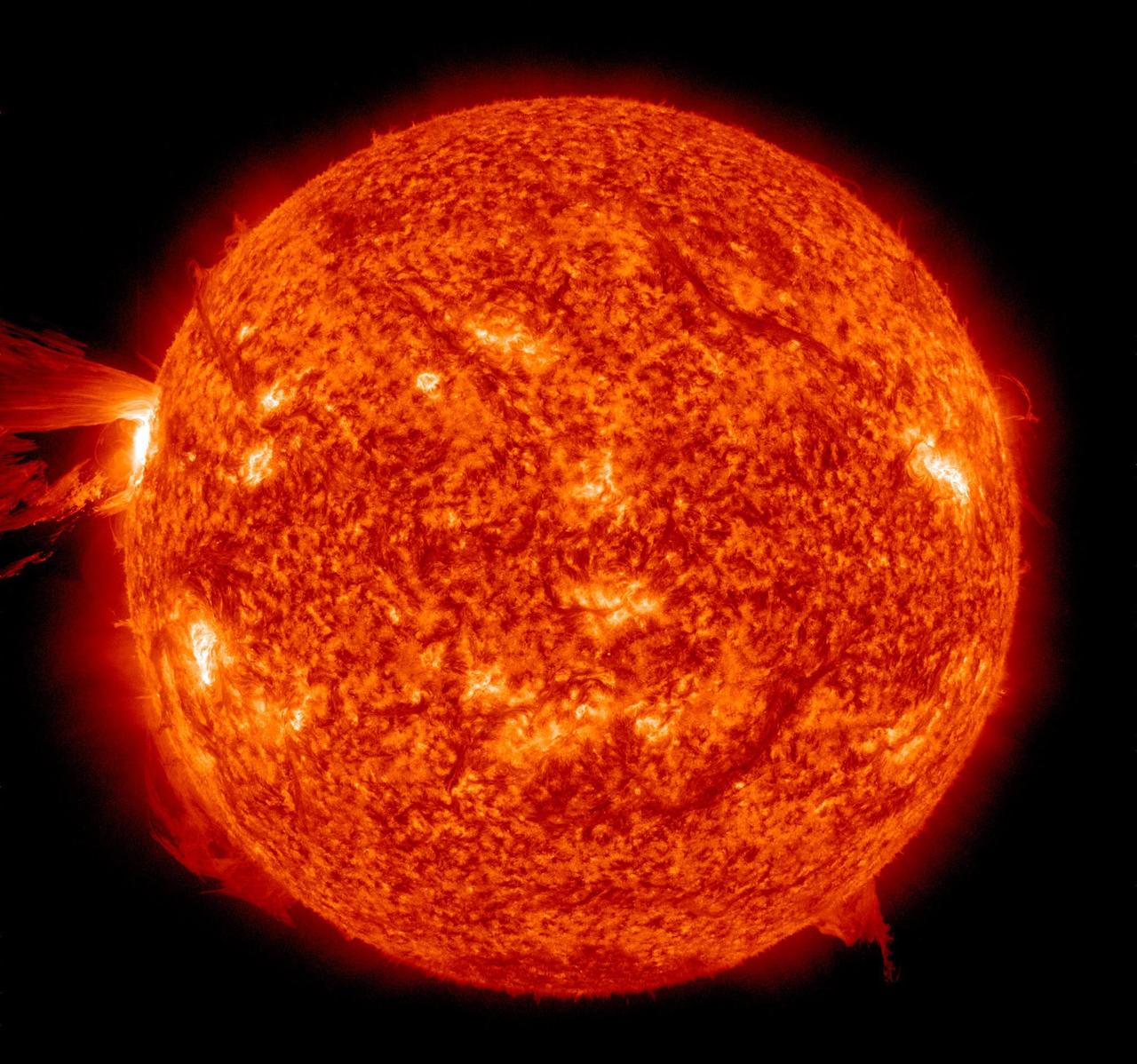
Ultraviolet, colourised
Star
Sun
The Sun is a star – a gigantic ball of glowing gas. It is so big that more than a million Earths would fit inside it. Without its light and warmth there would be no life on Earth. Never look straight at it – that damages your eyes!
Fact file
- Type
- Star
- Diameter
- 1,391,000 km
- Temperature
- 5,500 °C on average
- Mass
- 333,000 Earth masses
- Gravity
- 27.9 times as strong as on Earth
- Escape velocity
- 618 km/s
- Length of day
- Rotation takes about 25 days at the equator and 35 days at the poles (the Sun is not solid)
Interesting facts about the Sun
- The Sun contains more than 99.8% of the total mass of our Solar System.
- Its core is about 15 million degrees Celsius – that is where hydrogen fuses into helium.
- Light from the Sun takes about 8 minutes and 20 seconds to reach Earth.
Frequently asked questions about the Sun
How hot is the Sun?
At its visible surface the Sun is about 5,500 °C, and in its core about 15 million °C. Its outer layer, the corona, is much hotter than the surface again, at more than a million degrees.
What is the Sun made of?
The Sun is about three quarters hydrogen and about one quarter helium. In its core, hydrogen fuses into helium. This produces the energy we feel as light and warmth.
How much longer will the Sun shine?
The Sun is about 4.6 billion years old and has used up roughly half of its fuel. In about 5 billion years it will swell into a red giant and then end its life as a white dwarf.
How long does sunlight take to reach Earth?
Sunlight takes about 8 minutes and 20 seconds to reach Earth. So we always see the Sun as it was a good 8 minutes ago.
Name and discovery
From Old English “sunne”; in Latin it is called “Sol” – hence “Solar System”.
Formation
The Sun formed about 4.6 billion years ago from a collapsing cloud of gas and dust (a “solar nebula”). Most of the mass gathered at the centre and ignited nuclear fusion.
Atmosphere
The visible “surface” (photosphere) is surrounded by a hot, thin corona, which appears as a glowing halo during solar eclipses and is millions of degrees hot – hotter than the photosphere itself, which still puzzles astronomers today.
Exploration
Probes such as NASA's Parker Solar Probe (since 2018) and the European Solar Orbiter (since 2020) study the Sun from close up to understand the solar wind and solar storms better.
Compared with Earth
In terms of volume, about 1.3 million Earths would fit inside the Sun. Its diameter is about 109 times that of Earth.
Structure: what the Sun looks like inside
- Core: Around 15 million °C. Every second, about 600 million tonnes of hydrogen fuse into helium here (nuclear fusion).
- Radiative zone: Energy travels outwards as light – swallowed and sent out again so many times that it takes around 100,000 years to reach the next layer.
- Convection zone: Hot gas rises as in a boiling pot, cools and sinks again. At the top lies the visible surface (photosphere) at around 5,500 °C.
- Corona: At over 1 million °C, the Sun's outer atmosphere is far hotter than its surface – why is one of the great mysteries of solar research.
Test your knowledge of the Sun
Roughly how long does sunlight take to reach Earth?
About 8 minutes. At a distance of 150 million km and the speed of light, it takes about 8 minutes and 20 seconds.
How much of the total mass of the Solar System is in the Sun?
More than 99.8%. All the planets, moons and asteroids together make up less than 0.2% – and most of that is Jupiter.
What does a “light-year” measure?
A distance. The distance light travels in one year: about 9.5 trillion km.
The full quiz with points and badges is in the 3D model under “Explore”.
The Sun in the tours
Books on this topic
Advertisement As an Amazon Associate I earn from qualifying purchases. All books
This site is free and has no banner ads. Here is how you can support it