Home › Space probes › James Webb Space Telescope
Space probe
James Webb Space Telescope
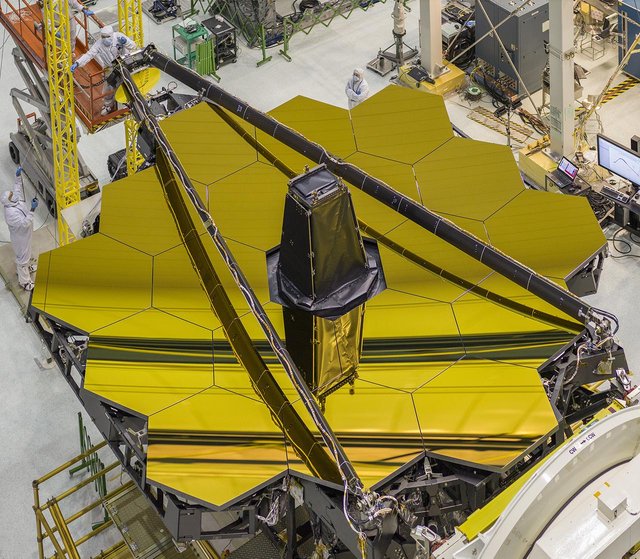
The James Webb Space Telescope is a giant telescope in space with a golden mirror. It can see so far that it can catch light from the very first stars and galaxies.
Fact file
- Type
- Space probe
- Launch
- 25 December 2021
Interesting facts about the James Webb Space Telescope
- Its main mirror is 6.5 m across and made up of 18 gold-coated hexagons – so large that it had to be folded up for launch.
- A sunshield the size of a tennis court keeps the telescope cold, at about -230 °C.
- It sees galaxies whose light has travelled more than 13 billion years to reach us – almost back to the beginning of the universe.
Frequently asked questions about the James Webb Space Telescope
Where is the James Webb Telescope?
The James Webb Telescope is about 1.5 million km from Earth, at the Lagrange point L2. There it travels around the Sun together with Earth.
What is the difference between James Webb and Hubble?
James Webb mainly observes infrared light, that is heat radiation, and at 6.5 m its mirror is much bigger than Hubble's 2.4 m one. This lets it see further back into the past and through clouds of dust.
When was the James Webb Space Telescope launched?
The mission began on 25 December 2021.
The mission
A joint project of NASA, ESA and the Canadian Space Agency, successor to the Hubble telescope. It took more than 25 years to develop.
Technology and flight
It observes in the infrared – heat radiation that passes through clouds of dust. That is why it has to be ice-cold itself, otherwise it would “dazzle” itself.
Discoveries
It sits 1.5 million km from Earth at the Lagrange point L2, where it travels around the Sun together with Earth. It studies the first galaxies, how stars form and the atmospheres of planets around other stars.
For comparison
L2 is about four times as far away as the Moon – from there the telescope always has the Sun, Earth and Moon behind its sunshield.
Mission milestones
- Launch
Launch at Christmas on a European Ariane 5 rocket from Kourou (French Guiana).
- Arrival at L2
After a month and more than 300 delicate unfolding steps, the telescope reaches its position.
- First images
The first colour images show galaxies and nebulae in sharpness never seen before.
Books on this topic
Advertisement As an Amazon Associate I earn from qualifying purchases. All books
This site is free and has no banner ads. Here is how you can support it