Home › Universe › Andromeda Galaxy (M31)
.jpg)
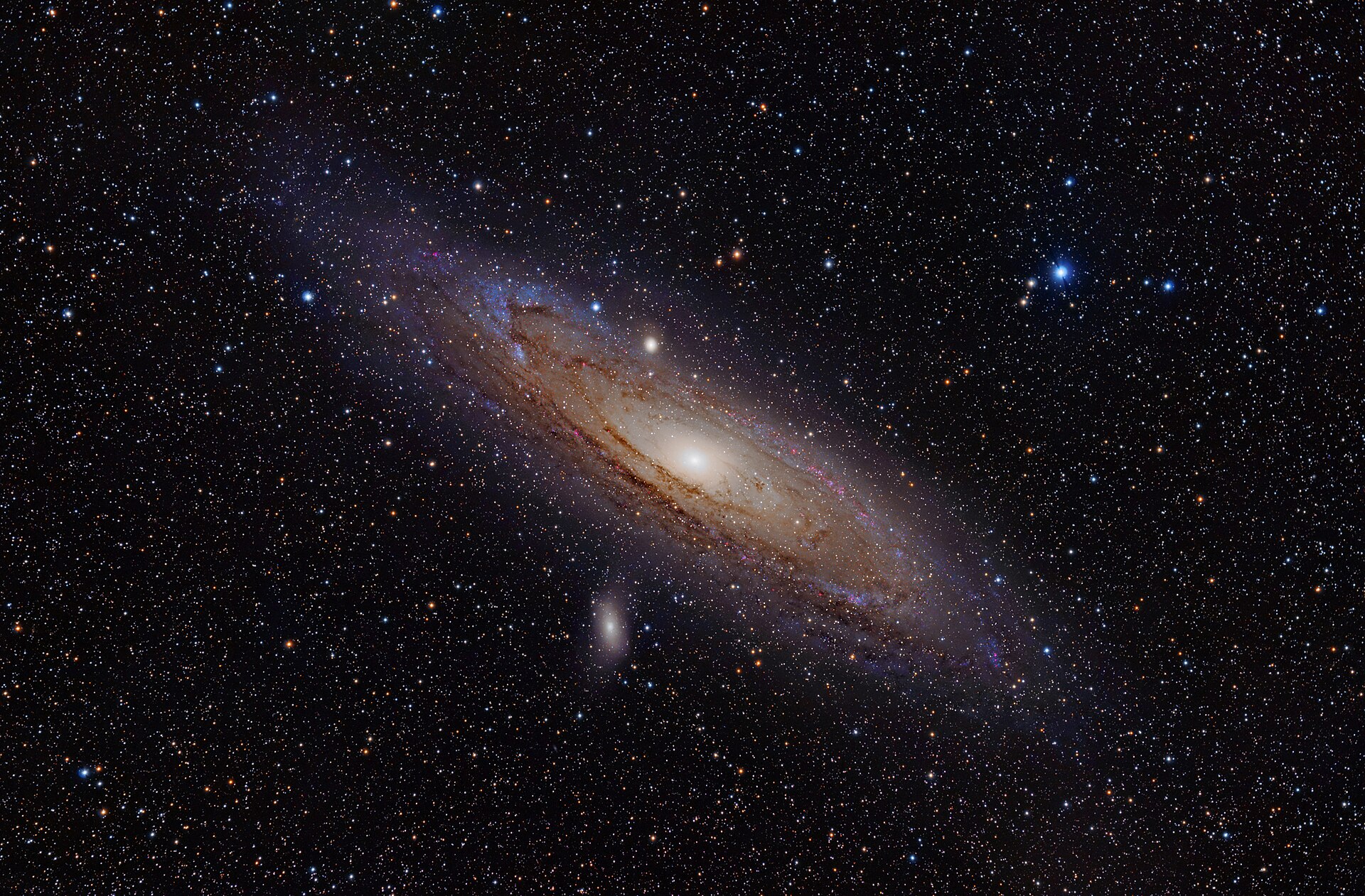
Spiral galaxy – the largest in the Local Group
Andromeda Galaxy (M31)
The most distant object you can see without binoculars: in autumn, under a dark sky, it can be found as an elongated misty patch in the constellation Andromeda.
Key figures
- Distance
- 2.5 million light-years
- Diameter
- about 220,000 light-years
- Stars
- about 1 trillion
- Mass
- about 1.2 trillion Suns
- Speed towards us
- 110 km per second
- Satellite galaxies
- over 30, e.g. M32 and M110
Interesting facts
- In the sky it is actually six times as wide as the Full Moon – just far too faint for the naked eye to see that.
- In 1923 Edwin Hubble used it to prove that there are galaxies outside the Milky Way. Until then it was thought to be a nebula in our own galaxy.
The great encounter
Andromeda and the Milky Way are falling towards each other. For a long time it was said that they would collide in about 4.5 billion years. New measurements with the Hubble and Gaia space telescopes (2025) show that it is about 50:50 whether this happens within the next 10 billion years – the gravity of the other galaxies is tugging too. If it does happen, the two will end up as one giant elliptical galaxy. The Sun would probably survive it.
Time travel in light
Its light has been travelling for 2.5 million years. So we see Andromeda as it was when the first humans of the genus Homo were just living on Earth.
How to find Andromeda Galaxy in the sky
Look for the Great Square of Pegasus. From its corner by the constellation Andromeda (Alpheratz), go two bright stars along to Mirach. From there, go two faint stars towards the W of Cassiopeia – right next to them lies an elongated, faint misty patch. With the naked eye only far from city lights; easy in binoculars. Best from September to January.
Visible with: the naked eye. More under Watching the sky.
Where is it?
Andromeda Galaxy (M31) belongs to the “The Local Group” level of the Cosmic Zoom (field of view about 10 million light-years). The Milky Way is not alone: together with the Andromeda Galaxy, the Triangulum Galaxy and around 80 small dwarf galaxies it forms the Local Group.
Books on this topic
Advertisement As an Amazon Associate I earn from qualifying purchases. All books
This site is free and has no banner ads. Here is how you can support it