Home › Universe › Cosmic microwave background
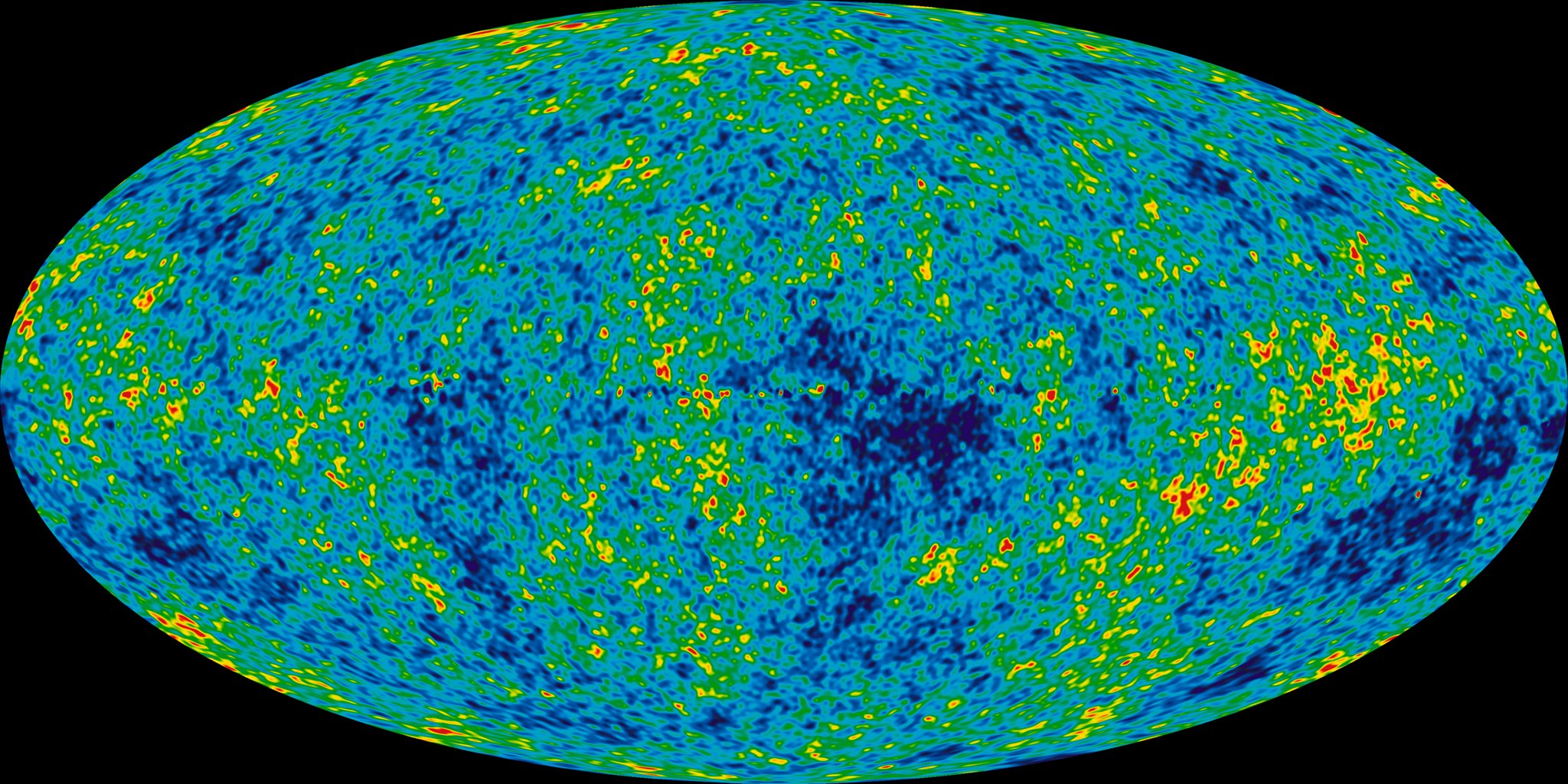

the oldest light in the universe
Cosmic microwave background
At first the discoverers thought the noise was interference – they even cleaned pigeon droppings out of their antenna. It stayed. In 1978 they received the Nobel Prize for it.
Key figures
- Set off
- 380,000 years after the Big Bang
- Temperature today
- 2.7 degrees above absolute zero (-270 °C)
- Differences
- only about 1 part in a hundred thousand
- Discovered
- 1964 by Arno Penzias and Robert Wilson
- Measured by
- COBE, WMAP and Planck
Interesting facts
- A small part of the “snow” on old televisions (with no channel tuned in) was background radiation – light from the beginning of the world in the living room.
- The tiny warmer and colder patches are the seeds of everything that came later: galaxy clusters, filaments and voids grew out of them.
Why exactly 380,000 years?
Before that the universe was a hot, opaque haze – like thick fog you cannot see through. When it had cooled to about 3,000 degrees, it suddenly became transparent. The light from that moment has been flying through space ever since. With light, we cannot look back any further.
Why can't we see it?
Back then it glowed bright orange, at about 3,000 degrees. The expansion of space has stretched the light waves to more than a thousand times their length. Today they are microwaves – invisible to our eyes, but radio telescopes measure them from every direction.
Where is it?
Cosmic microwave background belongs to the “The observable universe” level of the Cosmic Zoom (field of view about 93 billion light-years). As far as we can see at all. Light needs time – looking into the distance means looking into the past. At the edge glows the oldest light, from 380,000 years after the Big Bang. Right in the middle, invisibly small, is where we are.
This site is free and has no banner ads. Here is how you can support it