Home › Universe › The cosmic web
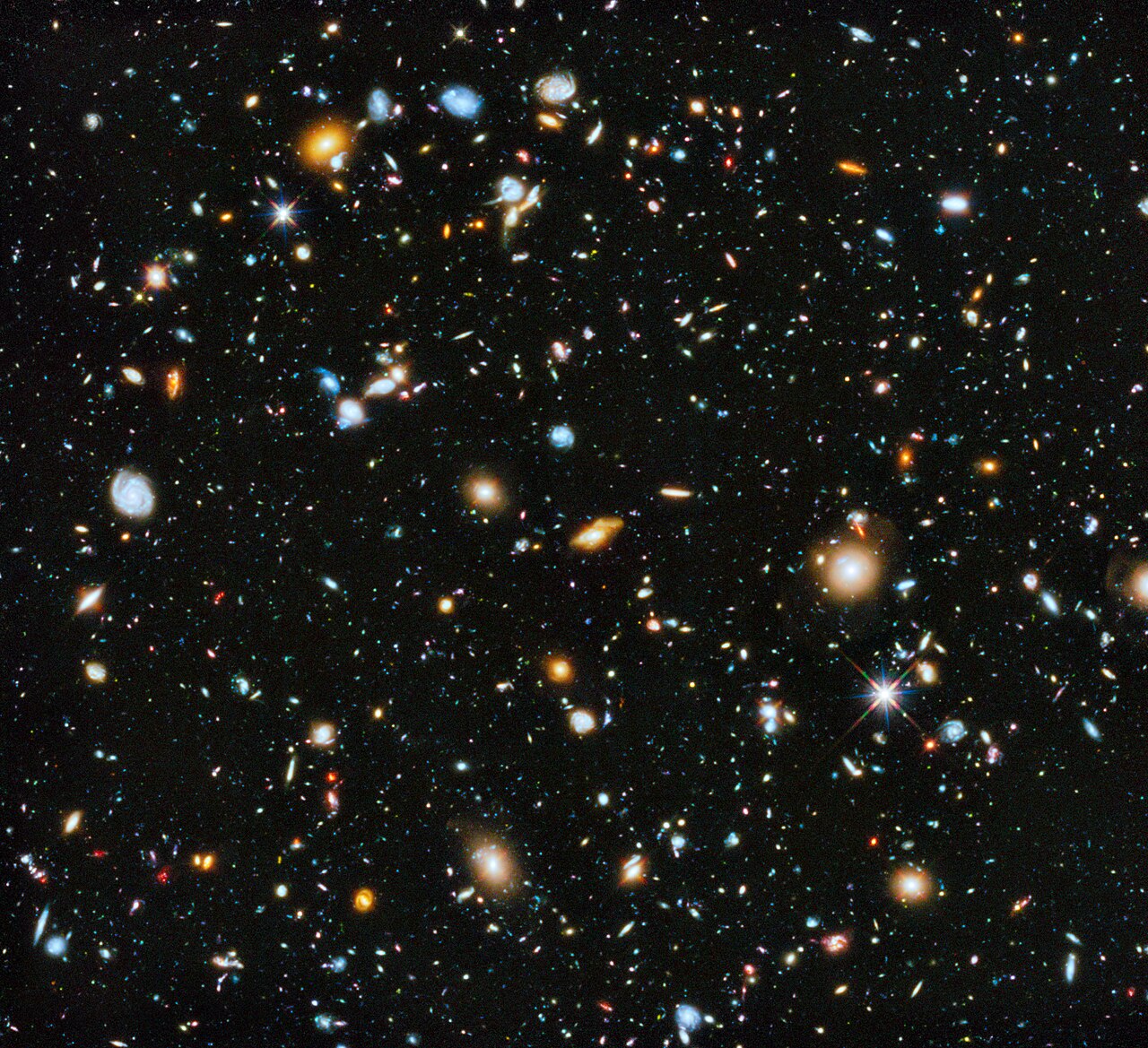

the largest structure in the universe
The cosmic web
Laniakea is Hawaiian and means “immeasurable heaven”. It contains about 100,000 galaxies – one of them is ours.
Key figures
- Age of the universe
- 13.8 billion years
- Observable universe
- about 93 billion light-years across
- Galaxies
- about 2 trillion
- Ordinary matter
- only about 5%
- Dark matter / dark energy
- about 27% / 68%
- Our supercluster
- Laniakea, about 520 million light-years across
Interesting facts
- The universe is expanding: the further away distant galaxies are, the faster they fly away from us. Edwin Hubble discovered this in 1929.
- The James Webb Space Telescope sees galaxies whose light set off when the universe was only about 300 million years old.
What is the web made of?
Galaxies gather in clusters and long filaments of dark matter. In between lie huge voids, with almost no galaxies. The pattern grew out of tiny irregularities shortly after the Big Bang.
The deepest image
For the Hubble Ultra Deep Field (image above) the telescope stared for more than a million seconds at a tiny, seemingly empty patch of sky – about a tenth as wide as the Full Moon. It found about 10,000 galaxies. Today the James Webb Space Telescope looks back even further, to shortly after the Big Bang.
A Swiss discovers the invisible
In 1933 the Swiss astronomer Fritz Zwicky found that the galaxies in the Coma Cluster were moving far too fast – there had to be much more mass than could be seen. He called it “dark matter”. To this day nobody knows exactly what it is made of.
Where is it?
The cosmic web belongs to the “The cosmic web” level of the Cosmic Zoom (field of view about 600 million light-years). Galaxies are spread out like dewdrops on a gigantic spider's web: in clusters and long filaments, with vast voids in between. Here the whole Local Group is a single point of light.
Books on this topic
Advertisement As an Amazon Associate I earn from qualifying purchases. All books
This site is free and has no banner ads. Here is how you can support it