
Comet
Comet Halley
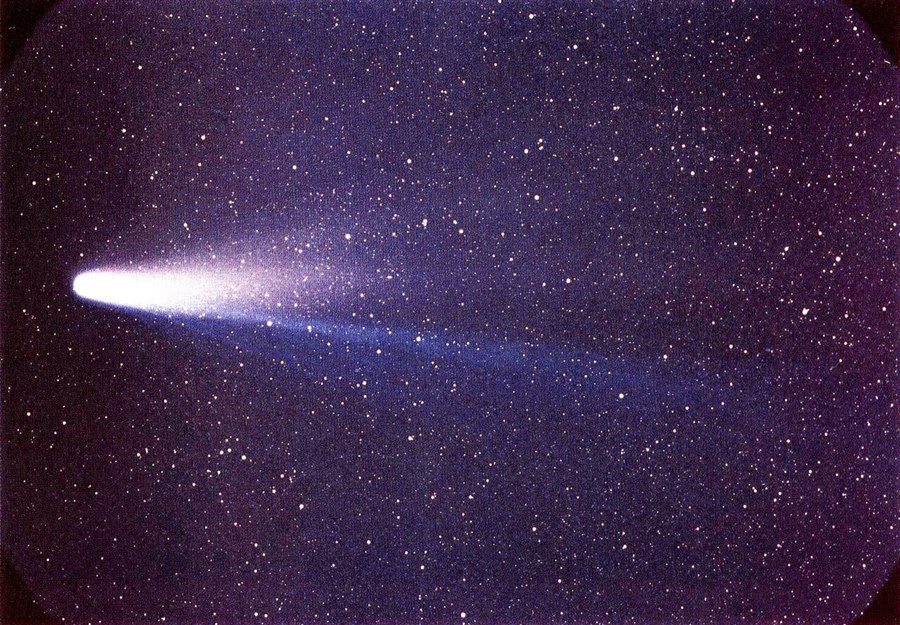
Halley's Comet is a dirty snowball of ice and dust. Every 76 years it comes close to the Sun and gets a long, glowing tail. The next time will be in 2061.
Fact file
- Type
- Comet
- Diameter of the nucleus
- 11 km
- Mean distance from the Sun
- 2,667,330,035 km
- Orbital period
- 75.3 years
- Shape of orbit (eccentricity)
- 0.967 – a very elongated ellipse
- Closest point to the Sun
- passed on 9 February 1986
Interesting facts about Comet Halley
- Halley returns about every 76 years – next time in July 2061.
- In 1705 Edmond Halley predicted that it would return in 1758. He did not live to see it, but the comet came – and has borne his name ever since.
- The writer Mark Twain was born in 1835 during a visit by Halley and died in 1910 at its next return – just as he had predicted.
Frequently asked questions about Comet Halley
When will Halley's Comet return?
Halley's Comet comes close to the Sun about every 76 years. It was last seen in 1986, and the next time will be in July 2061.
Why is it called Halley's Comet?
Edmond Halley realised that several comets that had been observed were one and the same, and in 1705 predicted its return for 1758. The comet came as calculated. Halley did not live to see it, but the comet has carried his name ever since.
Origin
A dirty snowball from the earliest days of the Solar System: ice, dust and dark organic matter. Its nucleus measures about 15 x 8 km.
Coma and tail
Near the Sun, ice turns to gas and forms an envelope (the coma) and two tails: a bluish gas tail and a yellowish dust tail – both point away from the Sun.
Exploration
In 1986 the European probe Giotto flew past the nucleus at a distance of only 600 km: it is as black as coal. Halley has been observed for more than 2,200 years.
Connection with Earth
Halley's dust trail crosses Earth's orbit twice a year: in May (Eta Aquariids) and in October (Orionids) it gives us shooting stars.
Comet Halley in the tours
This site is free and has no banner ads. Here is how you can support it