Planet
Mars
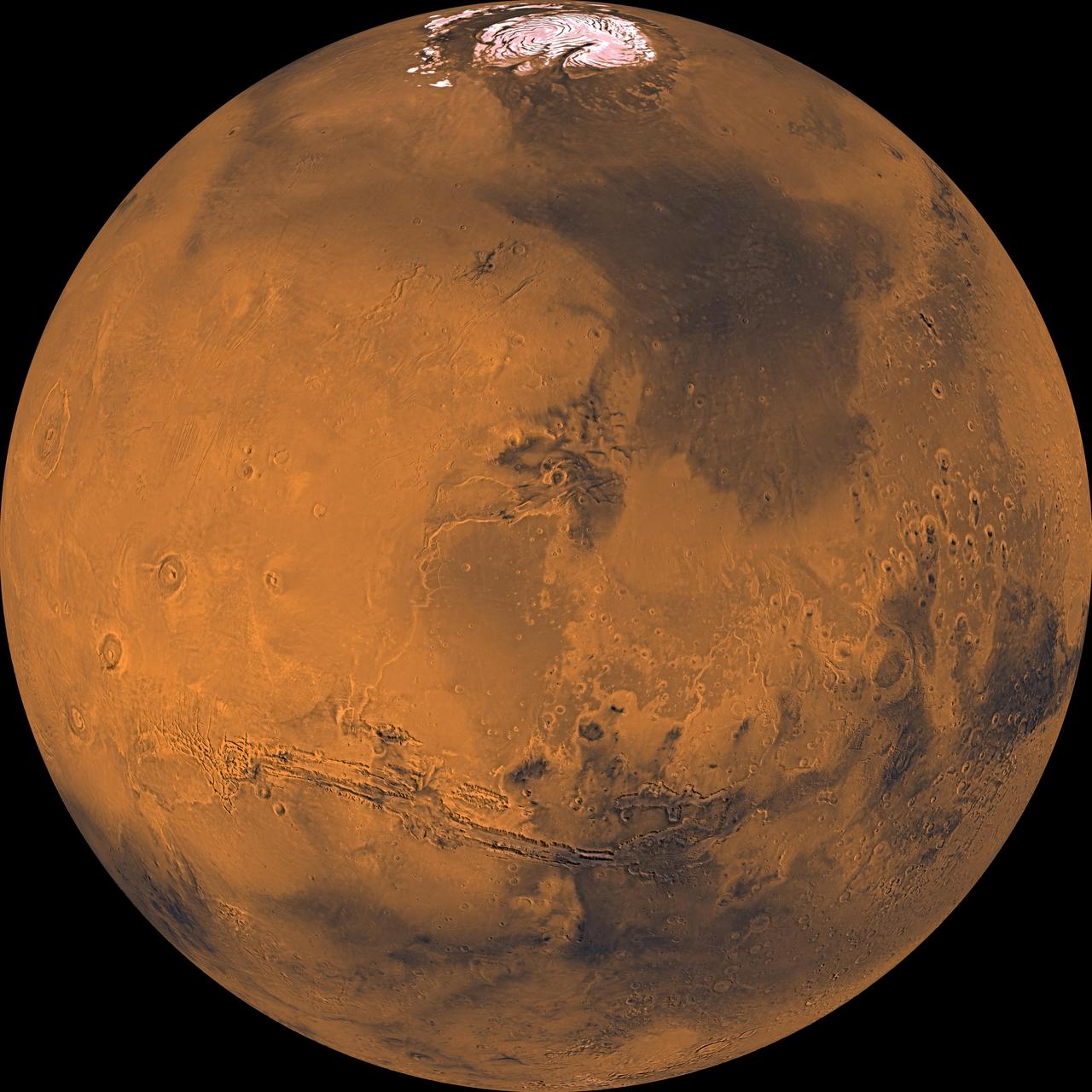
Mars is the red planet. It is red because its soil is full of rust. It has the highest mountain in the whole Solar System. Robot cars drive around on Mars looking for traces of life.
Fact file
- Type
- Planet
- Diameter
- 6,779 km
- Distance from the Sun
- 227,900,000 km
- Orbital period
- 687 days
- Shape of orbit (eccentricity)
- 0.093 (0 = circle)
- Orbital inclination
- 1.85° to Earth’s orbit
- Axial tilt
- 25.2°
- Temperature
- -63 °C on average (from -125 to 20 °C)
- Mass
- 0.107 Earth masses
- Gravity
- 0.38 times as strong as on Earth
- Escape velocity
- 5 km/s
- Length of day
- 24 hours 40 minutes (one “sol”)
- Number of moons
- 2
Interesting facts about Mars
- Mars is home to the largest known volcano in the Solar System: Olympus Mons, almost three times as high as Mount Everest.
- The red colour comes from iron oxide (rust) in the rock and dust.
- At 24h 40min, a Martian day (“sol”) lasts almost exactly as long as a day on Earth.
Frequently asked questions about Mars
Why is Mars red?
Mars is red because its rock and dust contain a lot of iron oxide. That is nothing other than rust. The fine dust lies all over the surface and even gives the sky a reddish tint.
Is there water on Mars?
Yes, but almost only as ice: at the poles and in the ground. Liquid water cannot last on the surface because the air pressure is less than 1% of the pressure on Earth. Mars was probably warmer and wetter in the past, with rivers and lakes.
Can people live on Mars?
Not without protection. The thin air is 95% carbon dioxide, and the average temperature is −63 °C. People would need spacesuits and sealed habitats. Even so, Mars is seen as the most likely destination for the first crewed journey to another planet.
How long does it take to fly to Mars?
With today's technology, a space probe takes about six to nine months to reach Mars. Launches are only possible roughly every 26 months, when Earth and Mars are well placed relative to each other.
How big is Mars?
Mars has a diameter of 6,779 km. That is about 53% of the diameter of Earth.
How far is Mars from the Sun?
Mars is on average 227.9 million km from the Sun. That is 1.52 astronomical units (AU). Sunlight takes about 12.7 minutes to cover this distance.
How long is a year on Mars?
Mars takes 687 days to travel once around the Sun. That is about 1.9 Earth years.
How many moons does Mars have?
Mars has 2 known moons. They are called Phobos and Deimos.
How cold or warm is it on Mars?
On Mars the average temperature is −63 °C. The temperature ranges from −125 to 20 °C.
Name and discovery
After the Roman god of war – because of its blood-red colour.
Visible to the naked eye – known since ancient times.
Formation
Mars formed 4.5 billion years ago and was probably once warmer and wetter, with rivers and lakes, before it lost its magnetic field and most of its atmosphere.
Atmosphere
Today's atmosphere is extremely thin (less than 1% of Earth's pressure) and is 95% carbon dioxide.
Exploration
Numerous rovers (Curiosity, Perseverance) and orbiters are actively exploring Mars; it is considered the most likely destination for the first crewed mission to another planet.
Compared with Earth
Mars is about half the size of Earth, but because of its lower density it has only about 38% of Earth's gravity.
Structure: what Mars looks like inside
- Core: Liquid iron with a lot of sulphur – in 2021 the InSight probe used marsquakes to show that the core is bigger than expected. Today, however, Mars no longer has a magnetic field.
- Mantle: A rocky mantle that once fed the giant Tharsis volcanoes.
- Crust: Around 25-70 km thick and rich in iron oxide – hence the red colour.
- Atmosphere: Very thin (1% of Earth's pressure), almost entirely carbon dioxide.
In reality the crust is wafer-thin – it is drawn thicker so that you can see it.
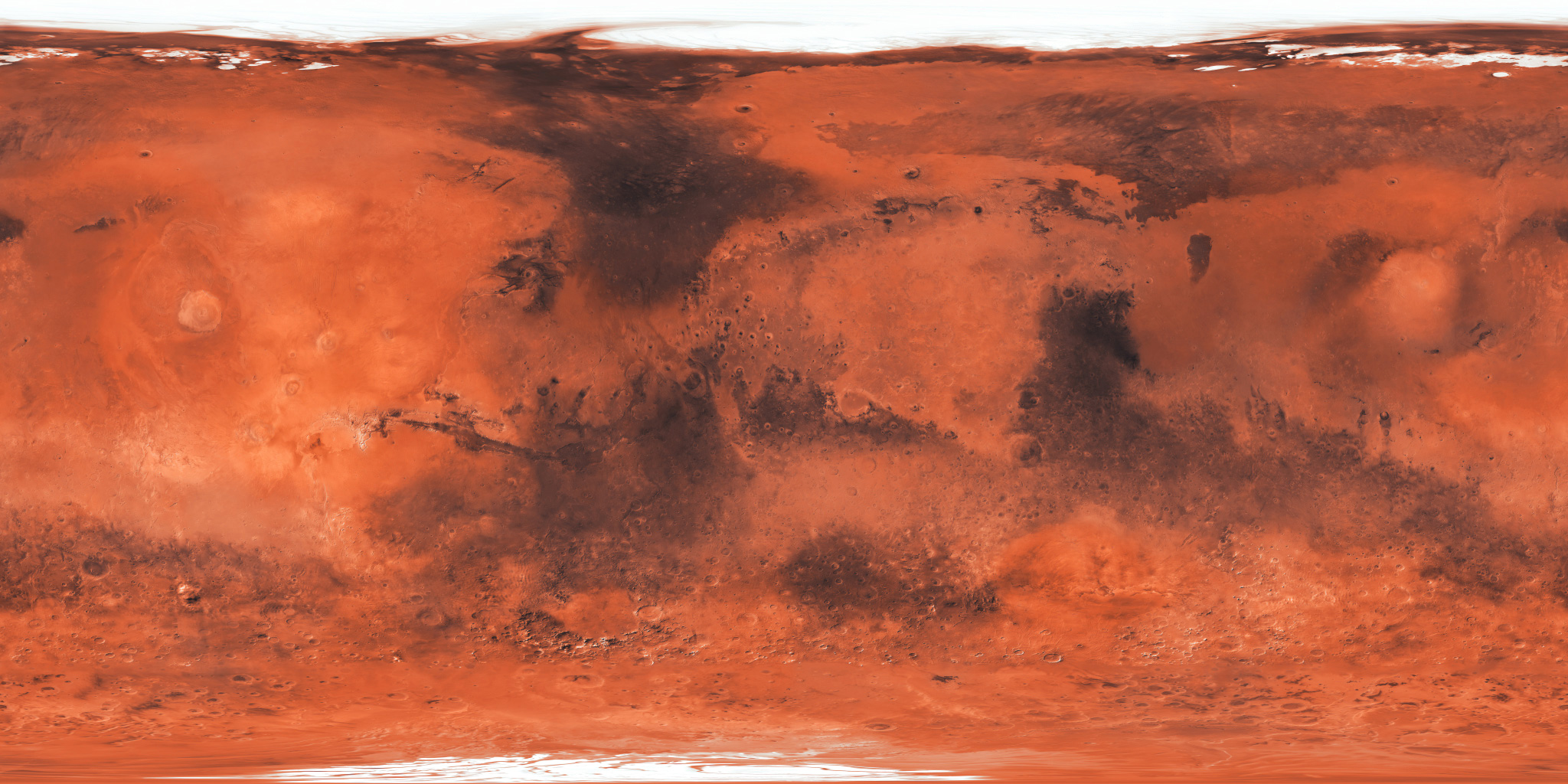
The surface: 34 places on Mars
Mountains and volcanoes
- Olympus Mons
- The highest volcano in the Solar System: around 22 km high and 600 km wide – as big as France. Its summit crater is 80 km across.
- Arsia Mons
- The southernmost of the three Tharsis volcanoes (around 17 km high), with an enormous summit caldera 110 km across.
- Pavonis Mons
- The middle Tharsis volcano, right on the equator (around 14 km high).
- Ascraeus Mons
- The northern Tharsis volcano (around 18 km high). The three volcanoes stand in a row on the huge Tharsis bulge.
- Alba Mons
- The largest volcano in the Solar System by area (more than 1,000 km wide), but only around 7 km high – very flat.
- Elysium Mons
- The main volcano of Elysium, the second-largest volcanic region on Mars – around 13 km high.
Regions
- Valles Marineris
- A gigantic canyon system: more than 4,000 km long and up to 7 km deep – on Earth it would stretch from Europe to America. Named after the Mariner 9 probe.
- Noctis Labyrinthus
- “Labyrinth of the Night”: a maze of troughs at the western end of Valles Marineris.
- Kasei Valles
- One of the largest outflow channels – carved by enormous floods when water still flowed on Mars.
- Syrtis Major
- A dark basalt region, drawn by Christiaan Huygens as early as 1659 as the first feature on another planet.
- Arabia Terra
- Ancient, heavily cratered highlands – one of the oldest landscapes on Mars.
- Cydonia (“Face on Mars”)
- In 1976 Viking 1 spotted a hill here that looked like a face on a blurry photo. Later sharp images showed it is simply a mesa.
- North polar cap
- A cap of water ice up to 3 km thick; in winter carbon dioxide (dry ice) from the air also freezes onto it.
- South polar cap
- A smaller polar cap with a permanent layer of dry ice on top of water ice.
Seas and plains
- Hellas Planitia
- A huge impact basin (2,300 km), up to 7 km deep. At the bottom the air pressure is so high that liquid water could exist briefly.
- Argyre Planitia
- An impact basin (around 1,800 km) in the southern highlands.
- Utopia Planitia
- The largest known impact basin on Mars (3,300 km), with large amounts of ice lying beneath its floor.
- Acidalia Planitia
- A dark lowland plain in the north – the setting of the novel and film “The Martian”.
- Chryse Planitia
- A lowland plain into which the great outflow channels once emptied.
- Amazonis Planitia
- One of the smoothest plains in the Solar System, with relatively young lava.
Craters
- Schiaparelli
- A crater (around 460 km), named after Giovanni Schiaparelli, who described the supposed “canals of Mars” in the 19th century.
- Huygens
- A crater (around 470 km) in the southern highlands.
- Korolev (ice crater)
- A crater (82 km) filled all year round with a layer of ice up to 1.8 km thick.
Landing sites
- Viking 1 – landing site
- July 1976: the first successful landing on Mars with a long period of operation (more than 6 years).
- Viking 2 – landing site
- September 1976: landed in Utopia Planitia and photographed frost on the Martian ground.
- Mars 3 – landing site
- December 1971: the first soft landing on Mars – but the Soviet probe fell silent after only around 20 seconds.
- Pathfinder & Sojourner
- July 1997: Sojourner was the first rover on Mars, only the size of a microwave oven.
- Gusev crater – Spirit rover
- January 2004: Spirit was meant to work for 90 days – it turned out to be more than 6 years.
- Meridiani Planum – Opportunity rover
- January 2004: Opportunity drove more than 45 km and kept working for almost 15 years, until a dust storm covered its solar cells in 2018.
- Phoenix – landing site
- May 2008: dug near the north pole and found water ice just beneath the surface.
- Gale crater – Curiosity rover
- August 2012: the car-sized rover is exploring the 5 km high Mount Sharp and has found evidence of a former freshwater lake.
- InSight – landing site
- November 2018: measured more than 1,300 “marsquakes” with a seismometer and so explored the interior of Mars.
- Jezero crater – Perseverance & Ingenuity
- February 2021: Perseverance is collecting rock samples in a former river delta. The mini-helicopter Ingenuity made the first powered flight on another planet here.
- Zhurong – China's rover
- May 2021: China became the second country to land a rover successfully on Mars, in Utopia Planitia.
In the 3D model you can click on these places on the map.
Moons of Mars
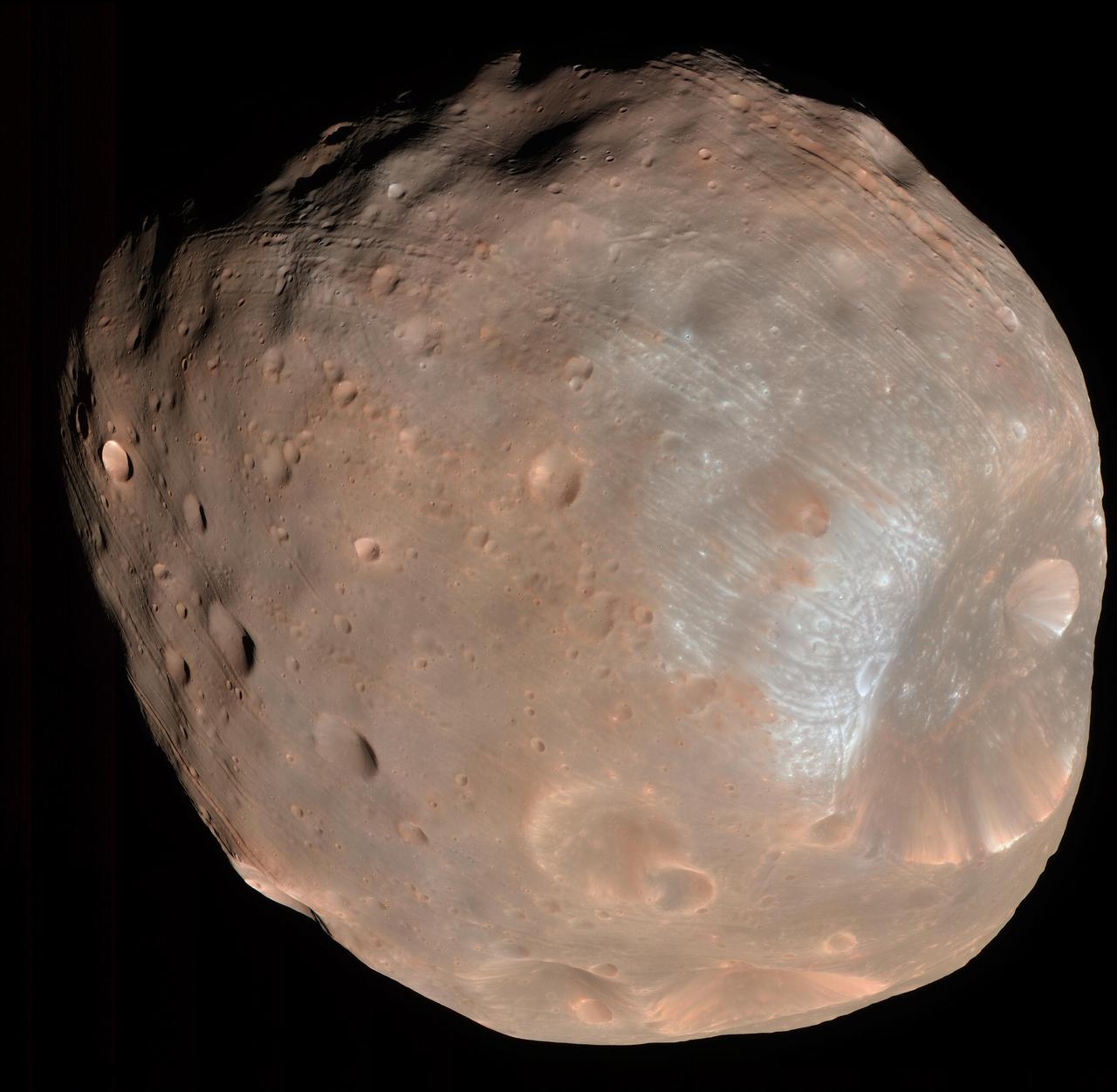 PhobosPhobos orbits Mars faster than Mars rotates: seen from Mars, it rises in the west and sets in the east …
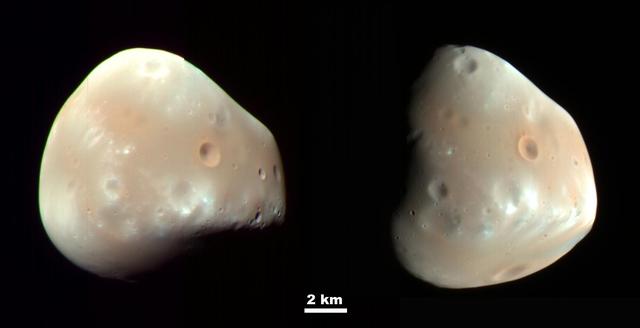 DeimosPhobos and Deimos mean “fear” and “dread” – after the sons of Ares, the god of war (Roman: Mars).
Space probes at Mars
Test your knowledge of Mars
Which planet has the highest mountain in the Solar System (Olympus Mons, about 22 km)?
Mars. Olympus Mons is an extinct shield volcano, almost three times as high as Mount Everest.
Which aircraft was the first to make a powered flight on another planet?
The mini helicopter Ingenuity. Ingenuity flew on Mars in 2021 – in an atmosphere only 1% as dense as Earth's.
What is the name of the giant canyon system on Mars?
Valles Marineris. More than 4,000 km long and up to 7 km deep – it would stretch from Europe to America.
What colour is a sunset on Mars?
Blue. Fine Martian dust scatters the blue light in the direction of the Sun – exactly the other way round from Earth.
The full quiz with points and badges is in the 3D model under “Explore”.
Mars in the tours
This site is free and has no banner ads. Here is how you can support it