Planet
Jupiter
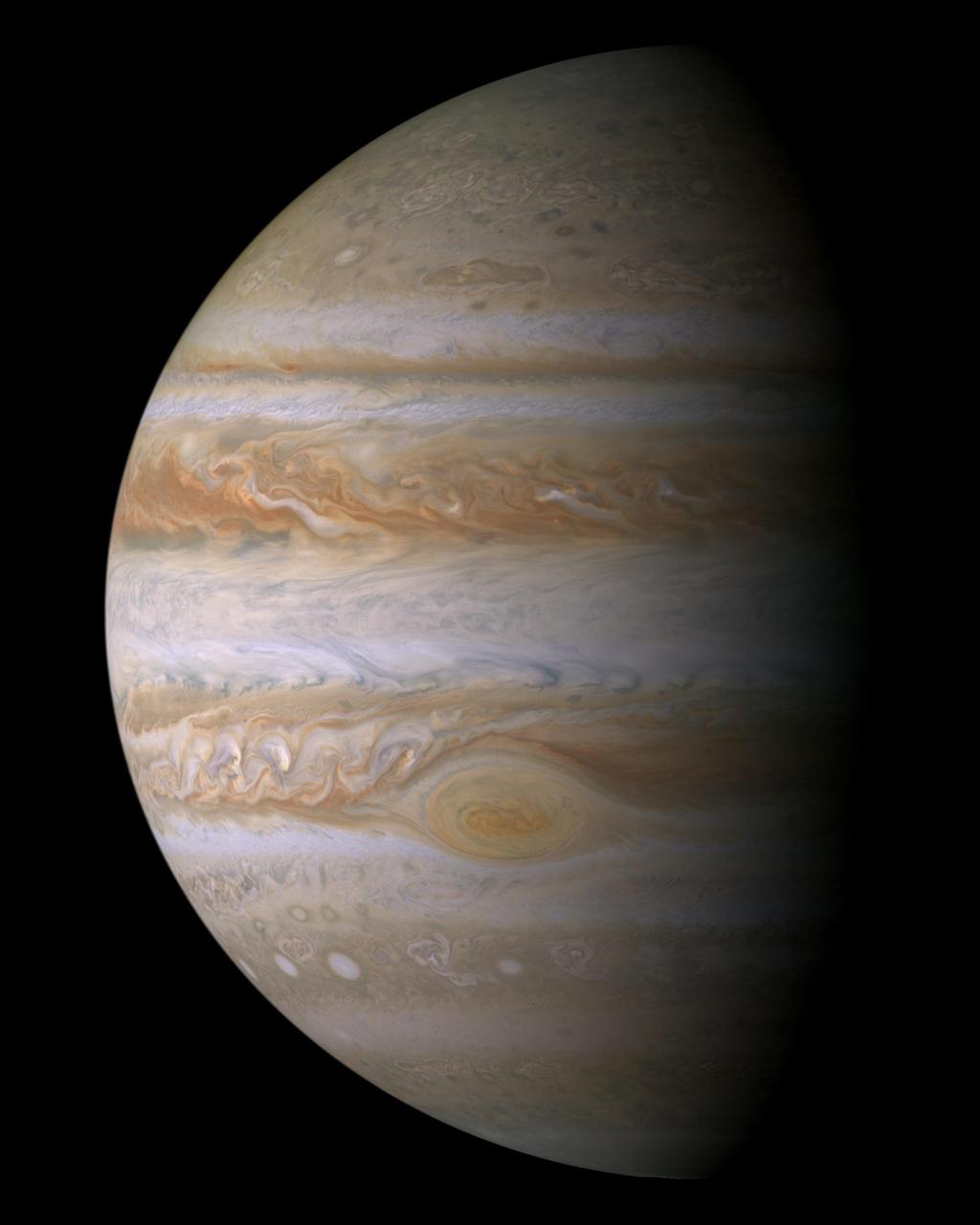
Jupiter is the biggest planet – all the other planets together would fit inside it. It has no solid ground; it is made of gas. Its red spot is a storm bigger than the whole Earth.
Fact file
- Type
- Planet
- Diameter
- 139,820 km
- Distance from the Sun
- 778,500,000 km
- Orbital period
- 11.9 years
- Shape of orbit (eccentricity)
- 0.049 (0 = circle)
- Orbital inclination
- 1.3° to Earth’s orbit
- Axial tilt
- 3.1°
- Temperature
- -108 °C on average
- Mass
- 318 Earth masses
- Gravity
- 2.53 times as strong as on Earth
- Escape velocity
- 59.5 km/s
- Length of day
- 9 hours 56 minutes – the shortest day of any planet
- Number of moons
- 97
Interesting facts about Jupiter
- Jupiter is the largest planet – more than twice as massive as all the other planets put together.
- The Great Red Spot is a storm that has been raging for at least 350 years and is bigger than Earth.
- Jupiter has 97 known moons (as of 2025) – only Saturn has more.
Frequently asked questions about Jupiter
What is the Great Red Spot?
The Great Red Spot is a gigantic storm in the atmosphere of Jupiter. It is bigger than Earth and has been raging for at least 350 years.
Can you land on Jupiter?
No. Jupiter is a gas planet made mostly of hydrogen and helium. It has no solid surface. Anything that flies in sinks deeper and deeper into denser and hotter gas.
Which are the largest moons of Jupiter?
Jupiter's four largest moons are called Io, Europa, Ganymede and Callisto. Galileo Galilei discovered them in 1610, which is why they are known as the Galilean moons. Ganymede is the largest moon in the whole Solar System.
How big is Jupiter?
Jupiter has a diameter of 139,820 km. That is about 11 times the diameter of Earth.
How far is Jupiter from the Sun?
Jupiter is on average 778.5 million km from the Sun. That is 5.2 astronomical units (AU). Sunlight takes about 43.3 minutes to cover this distance.
How long is a year on Jupiter?
Jupiter takes 11.9 Earth years to travel once around the Sun.
How many moons does Jupiter have?
Jupiter has 97 known moons. The best known include Io, Europa, Ganymede and Callisto.
How cold or warm is it on Jupiter?
On Jupiter the average temperature is −108 °C.
The ring system
Jupiter's rings were only discovered in 1979, by the Voyager 1 probe. They are made of fine, dark dust thrown up by impacts on the small inner moons, and are practically invisible from Earth.
Name and discovery
After Jupiter, the chief god of the Romans – fitting for the largest planet.
Visible to the naked eye – known since ancient times.
Formation
Jupiter was the first planet to form, probably within a few million years of the Sun, quickly sweeping up material from the protoplanetary disc as a gas giant.
Atmosphere
Jupiter is made mostly of hydrogen and helium, much like the Sun. Powerful bands of wind create its characteristic stripes.
Exploration
NASA's Juno probe has been orbiting Jupiter since 2016, studying its interior and magnetic field; earlier missions such as Galileo (1995-2003) also explored its moons.
Compared with Earth
Jupiter is 11 times the diameter of Earth – more than 1,300 Earths would fit inside it.
Structure: what Jupiter looks like inside
- Dilute core: The Juno probe showed that the core is not a solid lump but a fuzzy mixture of rock, ice and hydrogen.
- Metallic hydrogen: Under enormous pressure, hydrogen becomes a liquid, electrically conducting “metal soup”. It generates Jupiter's mighty magnetic field.
- Liquid hydrogen: Hydrogen and helium, ever denser further down. There is no solid ground anywhere – the gas gradually turns into liquid.
- Cloud layer: Bands of ammonia clouds with water clouds beneath. This is where the Great Red Spot and thunderstorms rage.
The cloud tops: 14 places on Jupiter
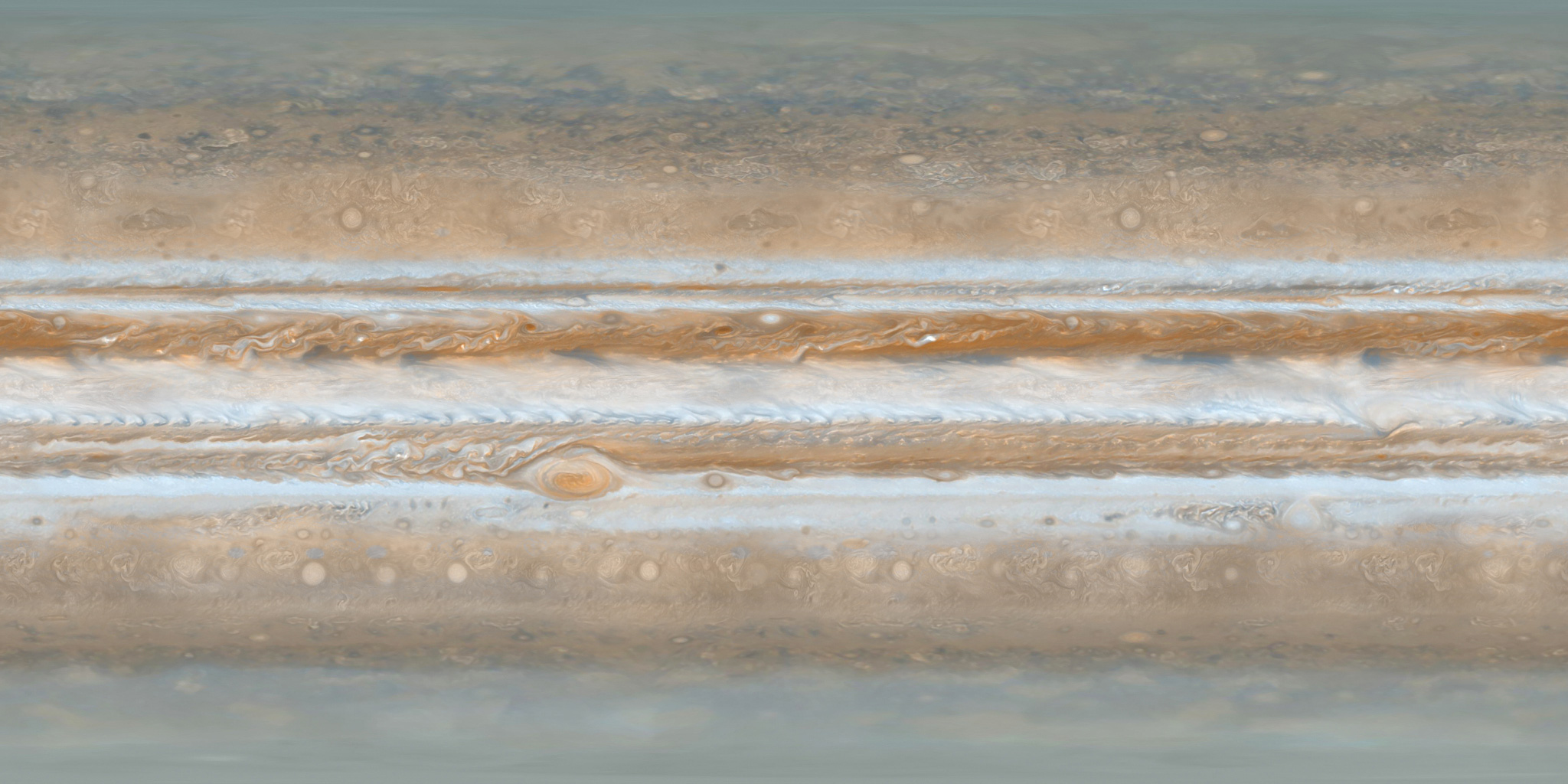
Jupiter has no solid surface – you are looking at the cloud tops. The cloud bands rotate at different speeds, so positions in longitude are only a snapshot.
Storms and clouds
- Great Red Spot
- A storm that has been raging for at least 190 years (probably more than 350 years) and is still bigger than Earth. It has been shrinking for decades, though. Winds at its edge: more than 400 km/h.
- Turbulent zone behind the Red Spot
- West of the Great Red Spot the clouds streaming past churn into chaotic eddies – like water behind a rock in a river.
- White ovals
- A chain of white storms in the South Temperate Zone. Three of them merged in 1998-2000 to form “Oval BA”, which turned red in 2006 and has been known as “Red Spot Junior” ever since.
- Storms of the North Temperate Zone
- Bright storms in the north – each of them about the size of one of Earth's continents.
- North polar cyclones
- The Juno probe discovered in 2017 that eight huge storms circle the north pole, forming an octagon around a central cyclone.
- South polar cyclones
- At the south pole five (at times six) cyclones form a pentagon around a central vortex – a stable pattern that still puzzles researchers.
- “Hot spot” (hole in the clouds)
- Dark patches on the edge of the North Equatorial Belt: holes in the cloud cover through which you can see down into deeper, warmer layers.
Regions
- Equatorial Zone
- A bright cloud band of ammonia ice over the equator, where winds blow eastwards at around 400 km/h.
- North Equatorial Belt
- A dark, reddish-brown band (a “belt”), where sinking air opens up the view of deeper, coloured clouds.
- South Equatorial Belt
- The dark band in which the Great Red Spot lies. Now and then it fades almost completely for a few years and then returns with outbursts.
- North Tropical Zone
- A bright “zone” of rising air with fresh, white ammonia clouds.
- South Tropical Zone
- A bright zone south of the Red Spot.
Craters
- Shoemaker-Levy 9 – impacts
- In July 1994, 21 fragments of this comet plunged into Jupiter (at around 44° south). The dark impact scars were bigger than Earth and visible for weeks. Position on the map is symbolic.
Landing sites
- Galileo atmospheric probe
- On 7 December 1995 a capsule from the Galileo probe plunged into a “hot spot” like this and radioed back measurements for 58 minutes before it was destroyed by the pressure. Position is symbolic.
In the 3D model you can click on these places on the map.
Moons of Jupiter
Jupiter has 97 known moons. These 9 have a fact file of their own:
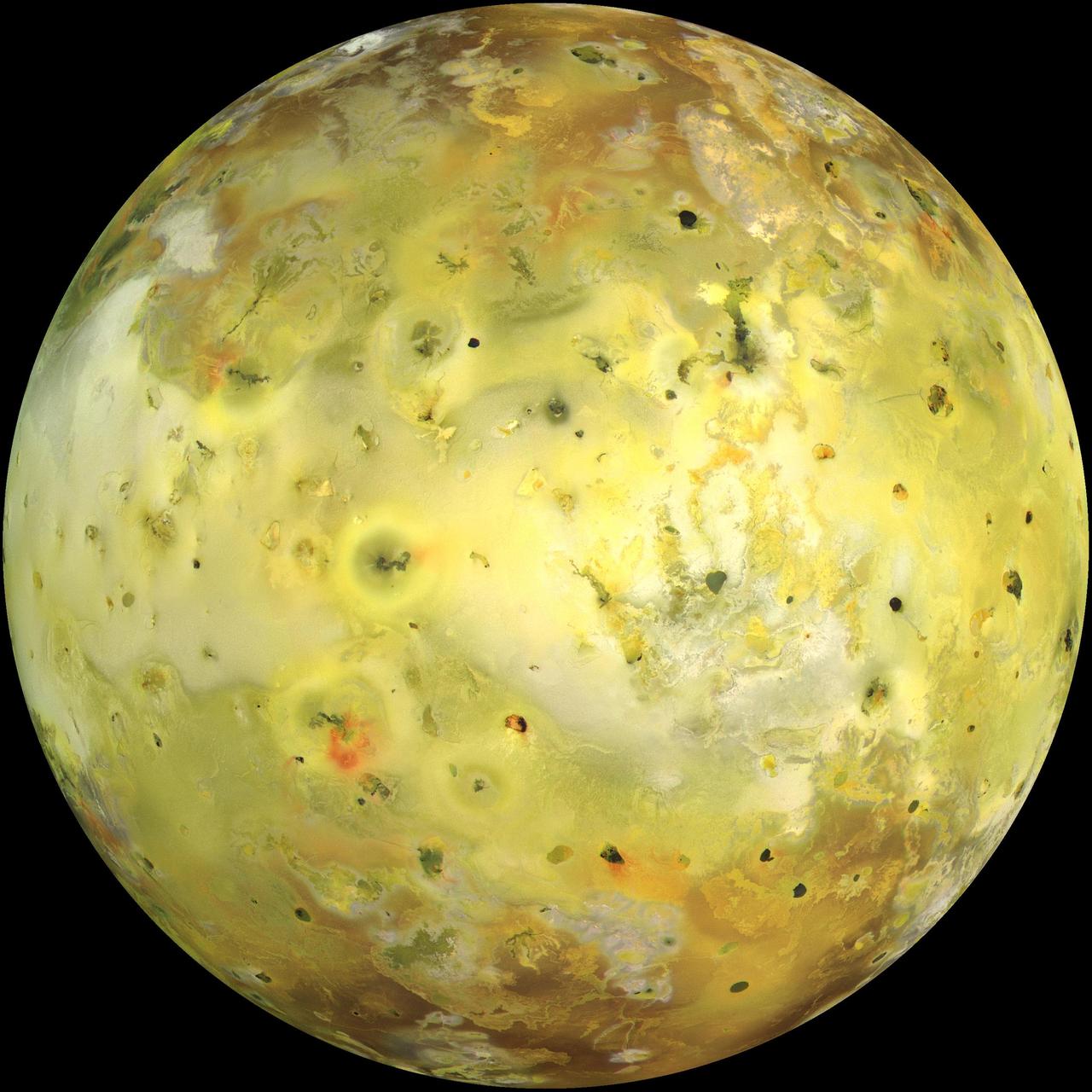 IoIo is the most volcanically active body in the entire Solar System, with hundreds of active volcanoes.
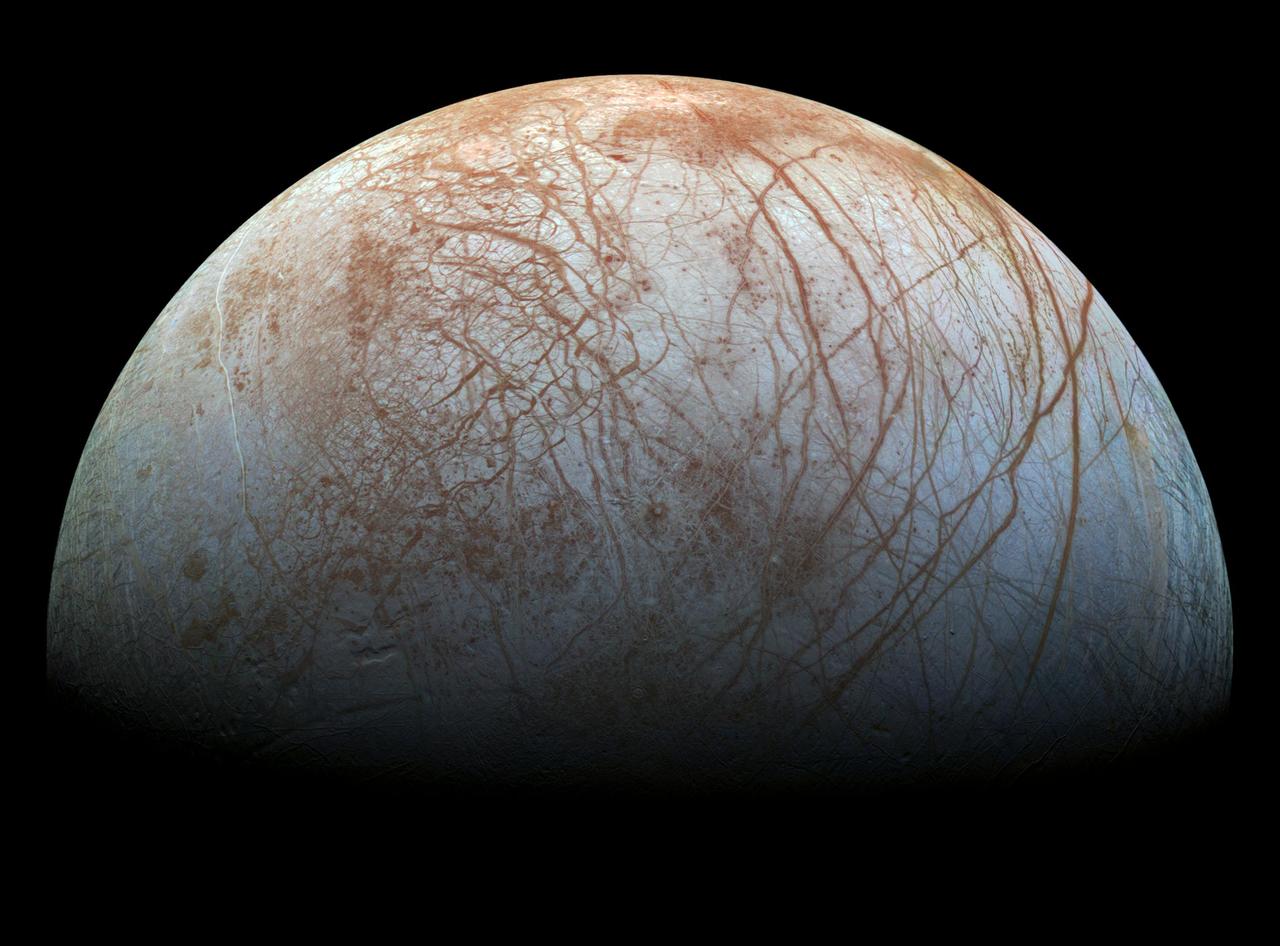 EuropaBeneath Europa's icy crust there is thought to be a global ocean of liquid water – with more water than all …
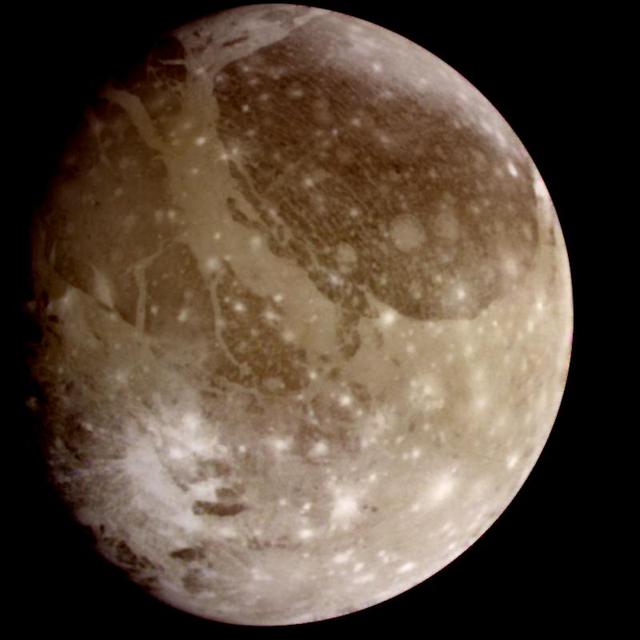 GanymedeGanymede is the largest moon in the Solar System – bigger than the planet Mercury.
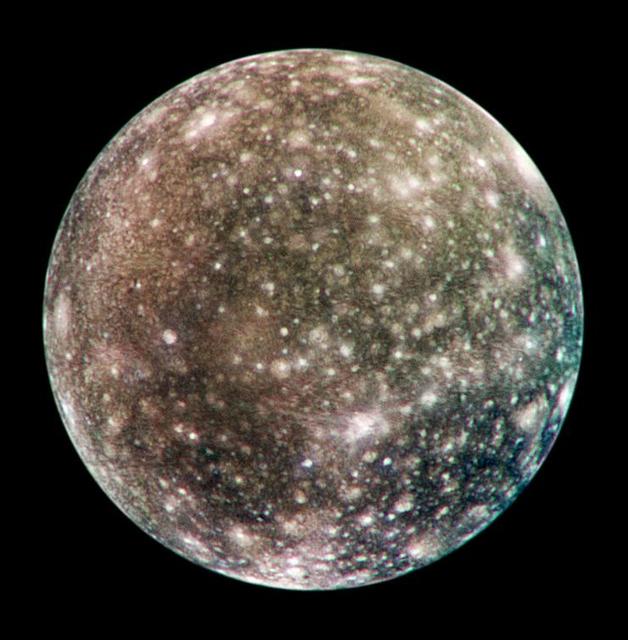 CallistoCallisto has the most heavily cratered surface in the entire Solar System.HimaliaHimalia is the largest of Jupiter's “irregular” moons, which circle far out on tilted, elongated orbits.ElaraElara was also discovered by Charles Perrine, in 1905, a year after Himalia.PasiphaePasiphae orbits Jupiter “the wrong way round” (retrograde) – a clear sign that it was captured.CarmeLike Pasiphae, Carme orbits Jupiter retrograde, and it gives its name to the Carme group.
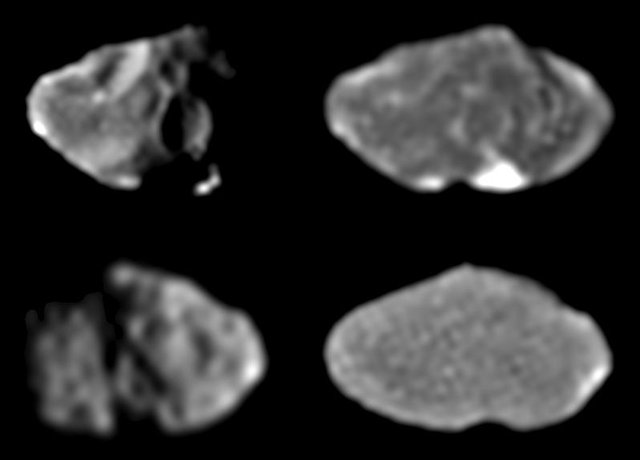 AmaltheaAmalthea is one of the reddest objects in the Solar System – probably because of sulphur drifting over from …
Space probes at Jupiter
Test your knowledge of Jupiter
Which is the largest planet in the Solar System?
Jupiter. Jupiter has more than twice the mass of all the other planets put together.
What is the name of the red storm on Jupiter that has been raging for centuries?
Great Red Spot. The Great Red Spot is an anticyclone that is still bigger than Earth but is slowly shrinking.
The full quiz with points and badges is in the 3D model under “Explore”.
Jupiter in the tours
This site is free and has no banner ads. Here is how you can support it