Moon of Jupiter
Io
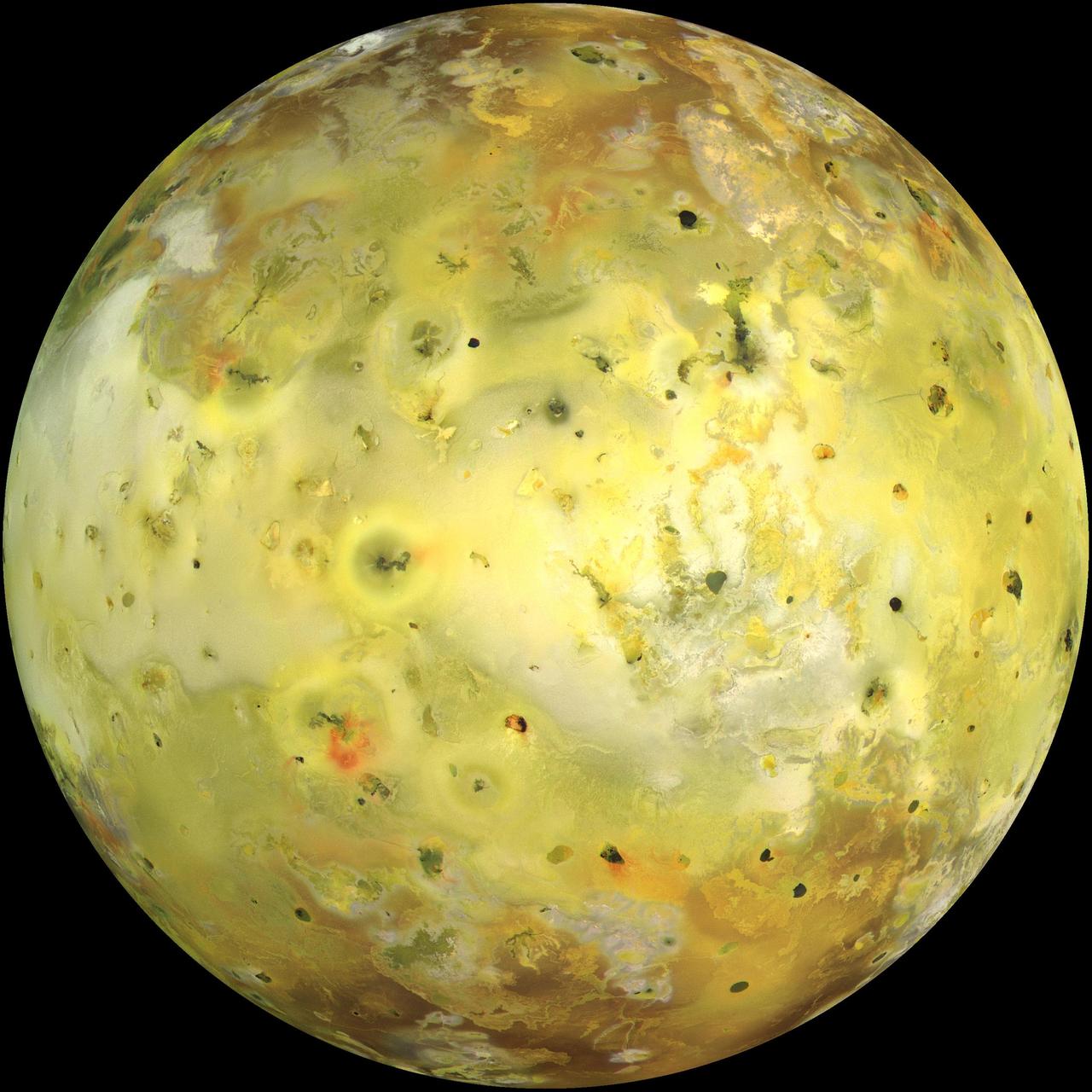
Io is a moon of Jupiter and has more volcanoes than any other place in the Solar System. It looks like a pizza: yellow, orange and with dark spots.
Fact file
- Type
- Moon of Jupiter
- Diameter
- 3,643 km
- Distance from Jupiter
- 421,700 km
- Orbital period
- 1.8 days
- Temperature
- -130 °C on average
- Mass
- 0.015 Earth masses
- Gravity
- 0.18 times as strong as on Earth
- Escape velocity
- 2.6 km/s
- Length of day
- 1.8 Earth days (tidally locked)
Io orbits Jupiter.
Interesting facts about Io
- Io is the most volcanically active body in the entire Solar System, with hundreds of active volcanoes.
- Its blaze of colour comes from sulphur compounds thrown out by the volcanoes.
- This extreme activity is constantly fuelled by Jupiter's tidal forces.
Frequently asked questions about Io
Why does Io have so many volcanoes?
Jupiter and the neighbouring moons constantly pull on Io and knead its interior. These tidal forces generate so much heat that Io has hundreds of active volcanoes. It is the most volcanically active body in the Solar System.
How big is Io?
Io has a diameter of 3,643 km. That is almost as big as our Moon.
How far is Io from Jupiter?
Io orbits Jupiter at an average distance of 421,700 km.
How long does Io take to orbit Jupiter?
Io orbits Jupiter once every 42.5 hours.
How cold or warm is it on Io?
On Io the average temperature is −130 °C.
Name and discovery
After Io, a lover of Zeus (the Roman Jupiter) in Greek myth.
Discovered on 7/8 January 1610 by Galileo Galilei – together with Europa, Ganymede and Callisto.
Formation
Io formed together with Jupiter's other large moons from the disc of gas and dust that surrounded the young Jupiter.
Atmosphere
Io has only an extremely thin, unstable atmosphere of sulphur dioxide, constantly topped up by volcanic eruptions.
Exploration
Voyager 1 (1979) discovered the active volcanoes; the Galileo probe (1995-2003) and Juno provided further detailed images.
Compared with Earth
Io is slightly larger than our Moon, but geologically far more active than any body in the inner Solar System.
The surface: 10 places on Io
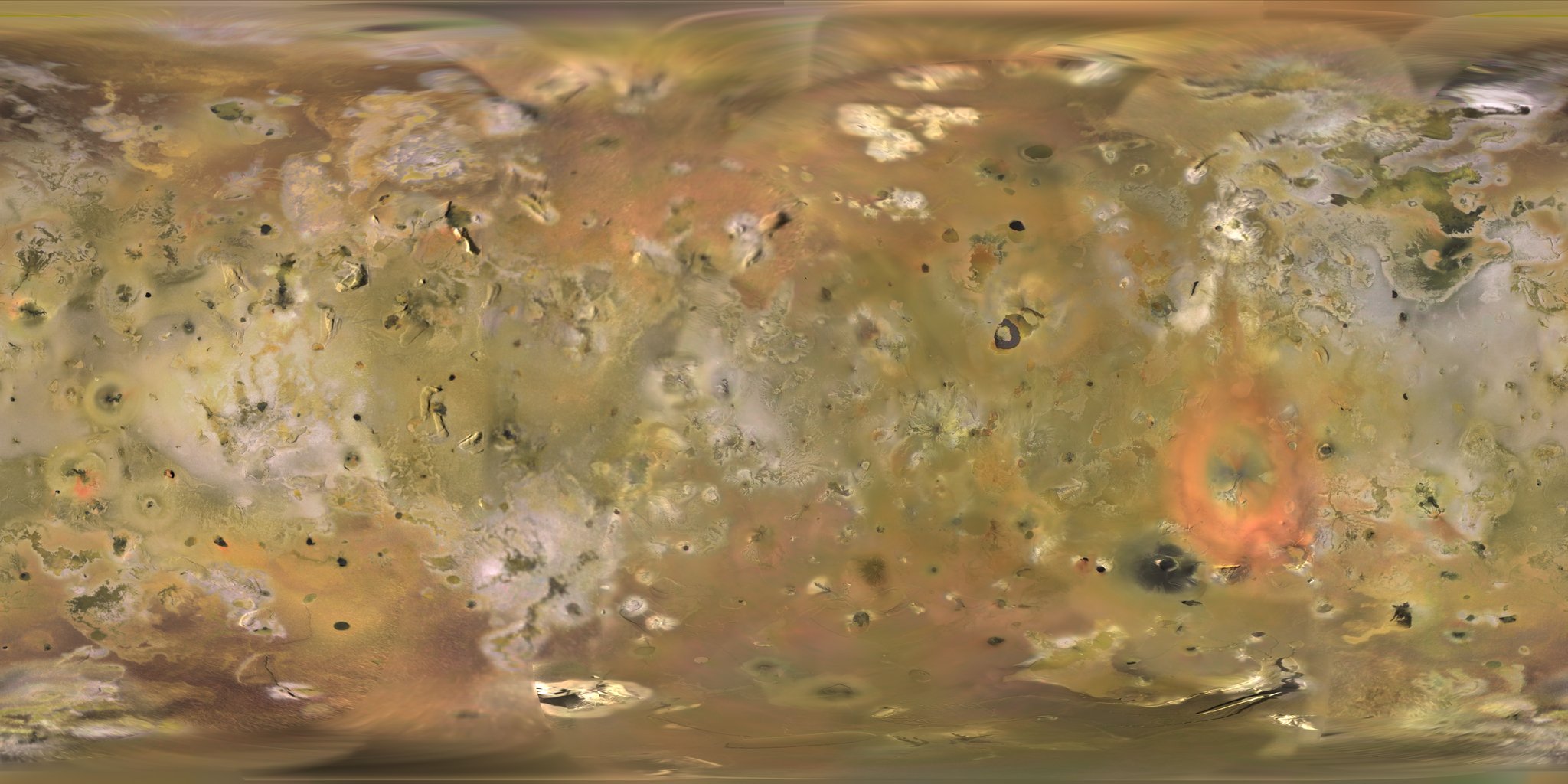
Io is constantly changing – new volcanic eruptions recolour the surface within months.
Mountains and volcanoes
- Pele
- A volcano whose plume of gas rises up to 300 km high. The sulphur raining back down forms a red ring more than 1,000 km in diameter – easy to see on the map.
- Loki Patera
- The most powerful volcano in the Solar System: a lava lake around 200 km across whose crust keeps breaking up and solidifying again.
- Prometheus
- Io's “Old Faithful”: its plume has been active almost without a break since the Voyager images of 1979.
- Tvashtar Paterae
- A volcanic region in the north. In 2007 the New Horizons probe photographed a plume 330 km high here as it flew past.
- Amirani
- One of the longest active lava flows in the Solar System runs here – more than 300 km long.
- Pillan Patera
- In 1997 Pillan erupted so violently that within months a dark patch the size of Austria had formed.
- Ra Patera
- A shield volcano with striking, bright flows of sulphur lava.
- Culann Patera
- One of the most colourful places on Io: red, green and yellow deposits of sulphur and silicates.
- Boösaule Montes
- The highest mountain on Io, around 17.5 km high – almost twice as high as Mount Everest. Io's mountains are not volcanoes but uplifted blocks of crust.
- Tohil Mons
- A mountain 5.4 km high with a volcanic depression at its foot.
In the 3D model you can click on these places on the map.
Other moons of Jupiter
Test your knowledge of Io
Which moon of Jupiter is the most volcanically active body in the Solar System?
Io. Tidal forces from Jupiter and the neighbouring moons knead Io and heat up its volcanoes.
The full quiz with points and badges is in the 3D model under “Explore”.
Io in the tours
This site is free and has no banner ads. Here is how you can support it