Moon of Earth
Moon
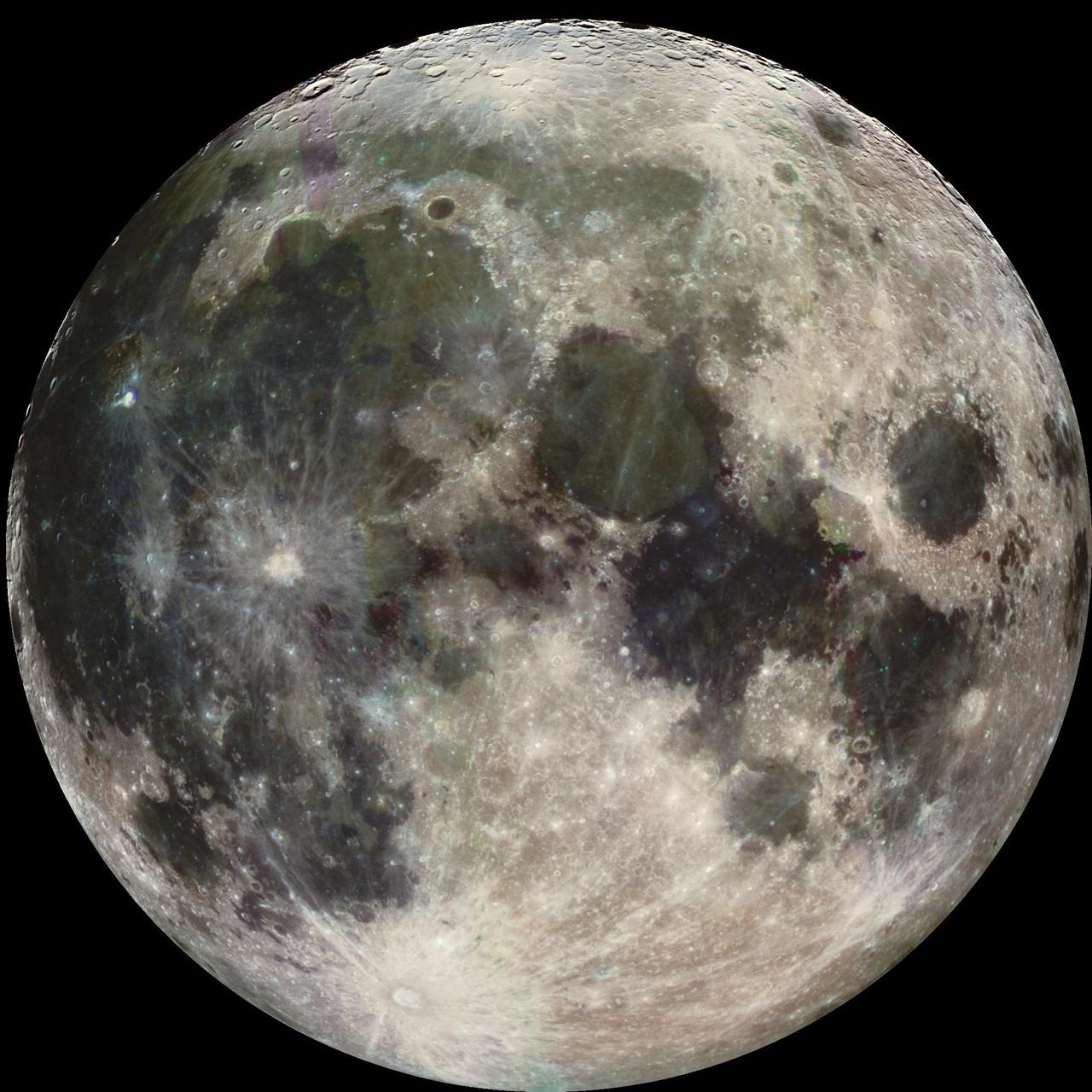
The Moon is our companion. It does not shine by itself; it is lit up by the Sun. That is why it sometimes looks round, sometimes like a half and sometimes like a crescent. 12 people have already walked around on it.
Fact file
- Type
- Moon of Earth
- Diameter
- 3,474 km
- Distance from Earth
- 384,400 km
- Orbital period
- 27.3 days
- Temperature
- -53 °C on average (from -173 to 127 °C)
- Mass
- 0.0123 Earth masses
- Gravity
- 0.17 times as strong as on Earth
- Escape velocity
- 2.4 km/s
- Length of day
- A lunar day lasts 29.5 Earth days (two weeks of day, two weeks of night)
The Moon orbits Earth.
Interesting facts about the Moon
- The Moon is “locked” to Earth (tidal locking) – from Earth we only ever see the same side.
- Every year it moves about 3.8 cm further away from Earth.
- Without the Moon, Earth's axis would be less stable, which would make the climate far more chaotic.
Frequently asked questions about the Moon
Why do we always see the same side of the Moon?
The Moon turns once on its axis in exactly the time it takes to travel once round Earth: 27.3 days. This is called tidal locking. That is why it always shows Earth the same side.
How did the Moon form?
About 4.5 billion years ago the young Earth probably collided with a body roughly the size of Mars, called Theia. The Moon formed from the debris that was flung into space.
What causes the phases of the Moon?
The Moon does not shine by itself. The Sun always lights up one half of it. Depending on where the Moon is on its orbit around Earth, we see more or less of this bright half. From one New Moon to the next takes 29.5 days.
How many people have been on the Moon?
Twelve people have walked on the Moon, all between 1969 and 1972 during the Apollo missions. The first were Neil Armstrong and Buzz Aldrin with Apollo 11.
How big is the Moon?
The Moon has a diameter of 3,474 km.
How far is the Moon from Earth?
The Moon orbits Earth at an average distance of 384,400 km.
How long does the Moon take to orbit Earth?
The Moon orbits Earth once every 27.3 days.
How cold or warm is it on the Moon?
On the Moon the average temperature is −53 °C. The temperature ranges from −173 to 127 °C.
Name and discovery
From Germanic “menon” – related to “month” and “measure”: the Moon was humankind's first clock.
Formation
The most widely accepted theory: about 4.5 billion years ago, a Mars-sized protoplanet (“Theia”) collided with the young Earth. The Moon formed from the debris.
Atmosphere
The Moon has practically no atmosphere, only an extremely thin “exosphere” – so there is no wind and no erosion, and footprints last for millions of years.
Exploration
Between 1969 and 1972, twelve people walked on the Moon during the Apollo missions. NASA's Artemis programme is planning new crewed landings.
Compared with Earth
The Moon is about a quarter the size of Earth – relative to its planet, the largest moon in the inner Solar System.
Structure: what the Moon looks like inside
- Inner core: A small, solid iron core (radius around 240 km).
- Outer core: A thin layer of liquid iron – detected through moonquake measurements by the Apollo seismometers.
- Partially molten layer: A soft zone in which the rock is partly molten.
- Mantle: Solid rock. It was the source of the dark lava that once filled the lunar seas.
- Crust: Around 30-50 km thick, thicker on the far side than on the near side.
In reality the crust is wafer-thin – it is drawn thicker so that you can see it.
The surface: 81 places on the Moon
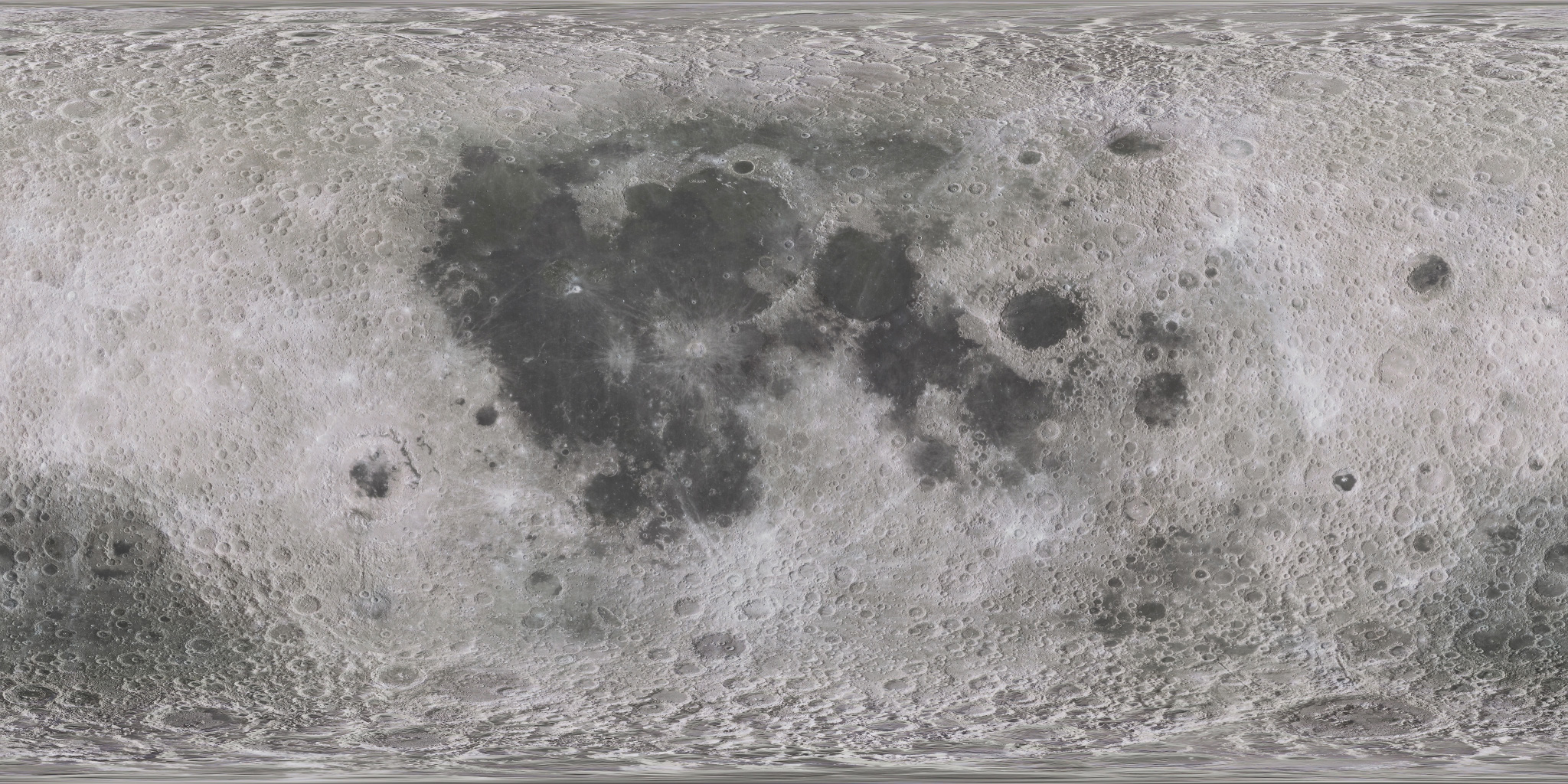
The left and right halves of the map (beyond ±90° longitude) show the far side, which can never be seen from Earth.
Seas and plains
- Mare Imbrium (Sea of Showers)
- The second-largest lunar sea, around 1,100 km across. It is the floor of a vast impact basin that formed about 3.9 billion years ago and was later flooded with dark lava. Easy to spot with the naked eye as the left “eye” of the Man in the Moon.
- Mare Serenitatis (Sea of Serenity)
- A round lava sea in the north-east of the Moon's near side, about 700 km across. Apollo 17 landed here in 1972, on the edge of the sea (Taurus-Littrow valley).
- Mare Tranquillitatis (Sea of Tranquillity)
- The dark lava plain where Apollo 11 landed in 1969. The name comes from the first maps of the Moon in the 17th century, when the dark areas were thought to be real seas.
- Mare Crisium (Sea of Crises)
- A strikingly isolated, oval sea on the eastern edge of the near side, around 560 km across. From Earth it can be seen with the naked eye as a dark patch on the right-hand edge.
- Mare Fecunditatis (Sea of Fertility)
- An elongated sea south of Mare Tranquillitatis. Several uncrewed probes landed here, among them the Soviet Luna 16, which in 1970 was the first to bring lunar samples back to Earth automatically.
- Mare Nubium (Sea of Clouds)
- A sea on the southern near side. The crater Tycho lies on its southern edge, and its bright rays reach right into this sea.
- Mare Humorum (Sea of Moisture)
- A small, almost circular sea on the western edge, about 390 km across, set in an ancient impact basin.
- Oceanus Procellarum (Ocean of Storms)
- The largest dark plain on the Moon, more than 2,500 km long. It is not a classic impact basin but a region with a great deal of ancient volcanism. Apollo 12 (1969) and several probes landed here, among others.
- Mare Frigoris (Sea of Cold)
- A narrow, elongated sea in the far north, stretching for around 1,600 km.
- Mare Vaporum (Sea of Vapours)
- A small lava sea (around 245 km) between Mare Imbrium and Mare Serenitatis, at the foot of the lunar Apennines.
- Mare Insularum (Sea of Islands)
- A lava plain around the craters Kepler and Copernicus, whose bright rays reach far across the sea.
- Mare Cognitum (Known Sea)
- Named in 1964 after the success of the Ranger 7 probe, which radioed back the first close-up images of the Moon from here before it crashed.
- Mare Nectaris (Sea of Nectar)
- A round sea (around 340 km) in an ancient impact basin. It is so typical that a whole era of lunar history – the “Nectarian” – is named after it.
- Mare Smythii (Smyth's Sea)
- A sea right on the Moon's eastern edge – visible from Earth only when the Moon's wobble (libration) is favourable.
- Mare Marginis (Sea of the Edge)
- An irregular sea on the Moon's eastern edge, north of Mare Smythii.
- Mare Undarum (Sea of Waves)
- A small, irregular lava field east of Mare Crisium.
- Mare Spumans (Foaming Sea)
- One of the smallest named seas (around 140 km), south of Mare Undarum.
- Mare Humboldtianum
- A sea on the north-eastern edge, named after the naturalist Alexander von Humboldt.
- Mare Australe (Southern Sea)
- A patchy region of many lava-filled craters on the south-eastern edge, most of it already on the far side.
- Mare Orientale (Eastern Sea)
- A spectacular ring basin 930 km across with three concentric mountain rings – like a bullseye. The youngest large basin on the Moon. It is called “eastern” because east and west used to be swapped on maps of the Moon.
- Mare Moscoviense (Sea of Moscow)
- One of the few seas on the far side. Discovered in 1959 on the very first photos of the Moon's far side, taken by the Soviet probe Luna 3.
- Sinus Iridum (Bay of Rainbows)
- A beautiful semicircular bay (236 km) on the edge of Mare Imbrium. At sunrise its mountain rim shines like a golden handle (the “Golden Handle”).
- Sinus Medii (Central Bay)
- Lies exactly in the middle of the Moon's near side – seen from here, Earth is always directly overhead.
- Sinus Aestuum (Seething Bay)
- A dark bay east of Copernicus with a floor of especially dark volcanic ash.
- Lacus Somniorum (Lake of Dreams)
- An irregular lava plain north-east of Mare Serenitatis. Smaller lava plains on the Moon are called “lakes”.
- Palus Putredinis (Marsh of Decay)
- A lava plain at the foot of the Apennines. Apollo 15 landed close by.
Craters
- Tycho
- A young crater (only about 108 million years old), 85 km in diameter. Bright rays spread out from it for more than 1,500 km across the lunar surface and are especially striking at full Moon.
- Copernicus
- A magnificent crater 93 km in diameter with terraced walls 3.7 km deep, around 800 million years old. It has a ray system and a central massif of uplifted rock.
- Kepler
- A small, young crater (32 km) with a bright ray system in Oceanus Procellarum, named after the astronomer Johannes Kepler.
- Aristarchus
- At 40 km, the brightest of the larger craters on the Moon's near side. It reflects a great deal of light and can be made out in earthshine even on the night side. Brief glows have been reported here time and again.
- Plato
- A large crater (101 km) in the north with a strikingly smooth, dark lava floor. Easy to see, even in small telescopes.
- Grimaldi
- A huge impact basin (172 km) on the Moon's western edge with a very dark, flat floor – one of the darkest places on the Moon.
- Clavius
- One of the largest visible craters (225 km) in the southern highlands, with a striking chain of smaller craters inside it. In the film “2001: A Space Odyssey” it is the site of the Moon base.
- Langrenus
- A large crater (132 km) on the eastern edge with a central peak and terraced walls.
- Tsiolkovskiy
- A crater on the far side of the Moon (180 km) with a strikingly dark lava floor and a tall central peak. It can never be seen from Earth.
- Ptolemaeus
- A huge, ancient crater (153 km) with a flat, lava-filled floor – part of a striking chain of craters with Alphonsus and Arzachel.
- Alphonsus
- A crater (108 km) with a central peak. In 1965 Ranger 9 crashed into it, sending back images on the way down that were shown live on US television.
- Arzachel
- A well-preserved crater (96 km) with a prominent central peak, the southernmost link in the Ptolemaeus chain.
- Archimedes
- The largest crater in Mare Imbrium (81 km). Its floor was later flooded with lava and is therefore completely smooth.
- Aristoteles
- A large crater (88 km) in the north with terraced walls; together with the smaller Eudoxus it makes a fine pair for small telescopes.
- Eudoxus
- A deep crater (67 km) south of Aristoteles.
- Posidonius
- A crater (95 km) on the eastern edge of Mare Serenitatis, its floor criss-crossed by rilles and cracks.
- Theophilus
- An impressive crater (100 km) with walls 4.4 km deep and a cluster of several central peaks.
- Proclus
- A small, very bright crater (28 km). Its rays are missing on one side – a sign that the impactor came in at a very shallow (oblique) angle.
- Petavius
- A large crater (177 km) on the eastern edge with central peaks and a long cleft in its floor.
- Gassendi
- A crater (110 km) on the northern edge of Mare Humorum. Its floor has been uplifted and is furrowed with rilles.
- Schickard
- A very large, shallow crater (227 km) in the south-west.
- Bailly
- At around 300 km, the largest crater on the near side – but because it lies close to the Moon's edge it is heavily foreshortened and hard to see.
- Maginus
- An ancient, heavily worn crater (194 km) in the southern highlands, close to Clavius.
- Giordano Bruno
- One of the youngest of the larger craters (22 km), formed only 1-10 million years ago – just beyond the eastern edge on the far side, with a bright ray system.
- South Pole-Aitken basin
- The largest and oldest known impact basin on the Moon: around 2,500 km across and up to 8 km deep. The impact probably dug up material from the Moon's mantle.
- Apollo (crater)
- A double-ring basin (524 km) on the far side, named in honour of the Apollo programme. Smaller craters inside it bear the names of astronauts who died, such as the Challenger crew.
- Korolev
- A ring basin (437 km), named after Sergei Korolev, the chief designer of the Soviet space programme.
- Hertzsprung
- A huge ring basin (570 km) on the far side, named after the Danish astronomer Ejnar Hertzsprung.
- Mendeleev
- A large basin (313 km) on the far side, named after the chemist Dmitri Mendeleev (periodic table).
- Daedalus
- A crater (93 km) almost exactly in the middle of the far side. Because the Moon shields this spot from Earth's radio interference, it is seen as an ideal site for a future radio telescope.
- Shackleton
- A crater (21 km) right at the south pole. Its floor lies in permanent darkness at around -180 °C – water ice is thought to be there. An important target area for future Artemis Moon landings.
Landing sites
- Apollo 11 – landing site
- On 20 July 1969 Neil Armstrong and Buzz Aldrin became the first people to set foot on the Moon here (“That's one small step for man ...”). The footprints and the descent stage are still there today, because there is no wind on the Moon.
- Apollo 12 – landing site
- November 1969: Pete Conrad and Alan Bean made a pinpoint landing next to the Surveyor 3 probe and brought parts of it back to Earth.
- Apollo 14 – landing site
- February 1971: Alan Shepard, the first American in space, hit two golf balls across the lunar surface here.
- Apollo 15 – landing site
- July 1971: the first mission with the lunar rover (Lunar Roving Vehicle) – between the Apennines and Hadley Rille.
- Apollo 16 – landing site
- April 1972: the only Apollo landing in the central highlands (Descartes Highlands).
- Apollo 17 – landing site
- December 1972: Gene Cernan and the geologist Harrison Schmitt in the Taurus-Littrow valley – the last people on the Moon so far.
- Luna 2 – impact
- September 1959: the Soviet probe Luna 2 crashed here – the first human-made object on another celestial body.
- Luna 9 – landing site
- February 1966: the first soft landing on the Moon and the first photos taken directly from the surface.
- Surveyor 1 – landing site
- June 1966: the first soft landing by the USA, in preparation for the Apollo missions.
- Lunokhod 1 – lunar rover
- November 1970: the first remote-controlled vehicle on another celestial body. It drove more than 10 km across Mare Imbrium.
- Chang'e 3 / Jade Rabbit
- December 2013: the first Chinese Moon landing, with the rover Yutu (“Jade Rabbit”).
- Chang'e 5 – sample return
- December 2020: the Chinese probe brought 1.7 kg of young lunar rock back to Earth – the first new lunar samples since 1976.
- Chang'e 4 – far side
- January 2019: the first landing ever on the far side of the Moon, in the crater Von Kármán. The radio link ran via a relay satellite.
- Chang'e 6 – far-side samples
- June 2024: brought rock samples from the far side of the Moon back to Earth for the first time (from the Apollo basin).
- Chandrayaan-3 – south polar region
- August 2023: India became the first country to land near the Moon's south pole.
Mountains and volcanoes
- Montes Apenninus (Lunar Apennines)
- The mightiest mountain range on the near side: around 600 km long, with peaks up to 5 km high (Mons Huygens). It is the upthrown rim of the Imbrium basin.
- Montes Alpes (Lunar Alps)
- A mountain range on the north-eastern edge of Mare Imbrium, around 250 km long, with peaks up to 3.6 km high – named after our Alps.
- Montes Caucasus (Lunar Caucasus)
- A mountain range between Mare Imbrium and Mare Serenitatis, with peaks up to around 6 km above their surroundings.
- Montes Carpatus (Lunar Carpathians)
- A mountain chain on the southern edge of Mare Imbrium, north of Copernicus.
- Mons Pico
- A solitary mountain 2.4 km high in the middle of the Mare Imbrium plain – a remnant of an inner basin ring.
Regions
- Vallis Alpes (Alpine Valley)
- A dead-straight valley 166 km long that cuts through the lunar Alps – a sunken trench with a fine lava rille running down its middle.
- Rima Hadley (Hadley Rille)
- A winding channel around 80 km long – a collapsed lava channel. The Apollo 15 astronauts drove the lunar rover right up to its edge.
- Rupes Recta (Straight Wall)
- A dead-straight scarp 110 km long in Mare Nubium – a fault where one side has dropped by 250-300 m.
- Reiner Gamma
- A mysterious bright swirl in Oceanus Procellarum with no difference in height. It is linked to a local magnetic field that shields the ground from the solar wind.
In the 3D model you can click on these places on the map.
Space probes at the Moon
Test your knowledge of the Moon
How many moons does Earth have?
1. The Moon is unusually large compared with its planet and keeps Earth's axis steady.
Why do we always see the same side of the Moon?
It turns on its axis exactly as fast as it orbits Earth. This is called “tidal locking”. Earth's tidal forces slowed the Moon down until it turned like this.
Who was the first person to set foot on the Moon, in 1969?
Neil Armstrong. Armstrong climbed out first and Aldrin followed. Meanwhile Collins orbited the Moon alone in the command module.
How many people have stood on the Moon so far?
12. Six Apollo missions landed on the Moon between 1969 and 1972, each with two astronauts.
The full quiz with points and badges is in the 3D model under “Explore”.
The Moon in the tours
This site is free and has no banner ads. Here is how you can support it