Home › Space probes › Apollo 11
Space probe
Apollo 11
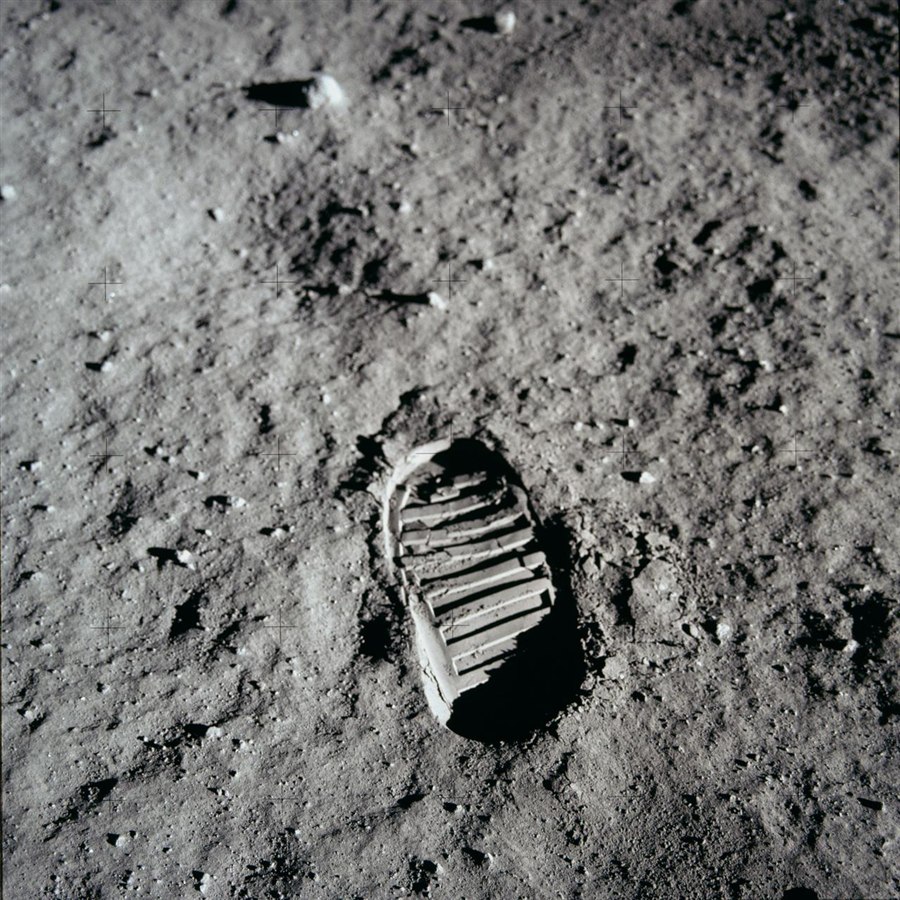
With Apollo 11, people landed on the Moon for the first time in 1969: Neil Armstrong and Buzz Aldrin. Their footprints are still there today, because there is no wind on the Moon.
Fact file
- Type
- Space probe
- Launch
- 16 July 1969
- End of mission
- 24 July 1969
Interesting facts about Apollo 11
- On 20 July 1969 Neil Armstrong and Buzz Aldrin became the first humans to set foot on the Moon – while Michael Collins orbited the Moon alone.
- The only non-American experiment on board came from Switzerland: the University of Bern's solar wind sail caught particles from the Sun.
- The on-board computer had less computing power than a pocket calculator today.
Frequently asked questions about Apollo 11
Who was the first person on the Moon?
Neil Armstrong became the first person to set foot on the Moon on 20 July 1969, followed shortly afterwards by Buzz Aldrin. In Europe it was already the early morning of 21 July. Michael Collins stayed in orbit around the Moon.
What did Switzerland have to do with Apollo 11?
The only non-American experiment on board came from Switzerland. The solar wind sail from the University of Bern caught particles from the Sun on the Moon.
What did Apollo 11 bring back from the Moon?
The astronauts collected 21.5 kg of Moon rock. They also set up instruments, including mirrors that are still used today to measure the distance to the Moon by laser.
When was Apollo 11 launched?
The mission began on 16 July 1969. It ended on 24 July 1969.
Which celestial bodies has Apollo 11 visited?
Apollo 11 visited the Moon. All milestones with their dates are listed further down this page.
The mission
Part of NASA's Apollo programme, set off by the Space Race with the Soviet Union. In 1961 President Kennedy had promised to put humans on the Moon before the decade was out.
Technology and flight
At 110 m tall, the Saturn V was for decades the largest rocket ever flown – its launch shook the ground kilometres away.
Discoveries
The astronauts collected 21.5 kg of Moon rock and set up instruments, including mirrors that are still used today to measure the distance to the Moon by laser to within centimetres.
For comparison
About 600 million people – a fifth of the world's population at the time – watched the landing live on television.
Mission milestones
- Launch at Earth
Launch of the Saturn V from Kennedy Space Center in Florida with Armstrong, Aldrin and Collins.
- Moon landing at the Moon
The lunar module “Eagle” lands in the Sea of Tranquillity. Armstrong: “That's one small step for man, one giant leap for mankind.”
- Lift-off from the Moon at the Moon
After 21.5 hours on the Moon, the lunar module lifts off and docks with the mother ship “Columbia”.
- Splashdown at Earth
The capsule lands in the Pacific. Afterwards the three astronauts have to spend three weeks in quarantine.
Apollo 11 in the tours
Books on this topic
Advertisement As an Amazon Associate I earn from qualifying purchases. All books
This site is free and has no banner ads. Here is how you can support it